Showing posts with label theleftpill. Show all posts

Wednesday, 29 March 2017


On Mycroft, Molly and Sherlock 
and the Christmas scene at Bart's
 (Sherlock meta by penelope1730 and theleftpill)

penelope1730:

How do Mycroft and Molly know one another? I understand this is Mycroft, who has greater vision than the All Seeing Eye of Sauron, but he seems rather comfortable – all things considered – in thanking Molly for her help. [...]

The Christmas scene from ASiB is the awkward gift that keeps on giving. Mycroft tells Sherlock he had Irene’s body brought to Bart’s, Sherlock’s “home away from home.” Molly is there to present the body for identification, with Sherlock telling her she didn’t have to come in.

Sherlock’s comment has always bothered me, though, beyond the lingering weirdness shared between he and Molly. Maybe it’s just me, but I thought it was a bit pretentious to tell Molly she didn’t have to come to work and, like, do her job. Although he’s self-employed, it’s doubtful Sherlock doesn’t understand that people actually have to show up for their employment when expected, even if he somehow feels entitled to tell them they don’t. Nice of him to want to spare her his presence, tho.

Molly’s reply also doesn’t make sense — “It’s okay, everyone else was busy with…Christmas” — if it’s actually her job to be there. Something along the lines of —- “Ummm, Sherlock, I’m not simply showing up for your convenience, especially as you were rude as fuck to me. This is my job and while it sucks to have to work on Christmas, it’s double-time with holiday bonus pay — cha ching! Let the other schmucks enjoy their turkey or goose – I’ll still be able to fit into my skinny jeans tomorrow.” would seem more appropriate.

Okay, so Molly probably wouldn’t say that – she hasn’t quite got her righteous snark down yet – but you get the drift.

Unless, of course, she wasn’t scheduled to work or on-call, which Sherlock might know, and someone (ahem, Mycroft) called her personally. Then Sherlock’s comment “You didn’t have to come in, Molly” makes sense, along with Molly’s “I don’t mind, everyone else is busy with…Christmas.”

So, if that’s what happened (and not saying it did), why would Mycroft call Molly, or have her on speed dial? Why not let the morgue attendant deal with the body, especially when one is always working? What difference would it make? It’s not like the morgue attendant would care. Was it about convenience? Mycroft circumventing normal channels? Moffat and Gatiss just wanted to give us one more angsty / awkward scene between Sherlock and Molly?

Or, did Molly decide, having just experienced the *worst Christmas party* in history, that going to work was like the best thing ever?

I gotta give Molly props for wanting to know who the dead, naked women was – and actually asked, without hesitation. She asked Mycroft, Mister Warm and Fuzzy, and people don’t think this chick has got a spine, or that she only grew one post Reichenbach. HA! And, then, later on – when she pumped Sherlock for info about whose phone he was x-raying. Seriously – how many people actually pump Sherlock for information, where he actually answers? This girl is far from spineless.

Any thoughts anyone???

theleftpill:

I think it’s clear from the context of this scene and the one before it that Molly’s presence in this scene is out of the ordinary - she’s not just “doing her job.” Since she was just at the party it’s clear that she had the night off, so simply fulfilling her duty isn’t at play here.

On a superficial, basic-viewer level, Molly’s there for subtle comic relief. She’s just been humiliated by her crush, (presumably) leaves the party when it breaks up with Sherlock’s departure, and takes a “hey can you come in to work, we’ve got a situation” call to get her mind off things. And is immediately confronted by same crush who identifies a woman by “not her face.” On the surface it’s another sucker-punch. But as I’ve asked before - Why Molly? Why is it Molly attending the viewing? Why not the on-duty attendant, or, given the political sensitivity of the matter, a government official? You’ve hit another key moment showing Molly’s importance, which I think goes deeper than quick comic relief.

I think you can safely draw the conclusion that Mycroft had Molly called in (I doubt he would have called her himself.) He’s working very hard to control the situation; he has control over the location and therefore would also have control of personnel. This is not just his brother’s conflict; it’s also a security risk. Mycroft trusts her with this rather delicate security situation - in a small way, she’s in the inner circle. He trusts her to be discreet and professional.

But the biggest reason, if you’re digging deep, is clear from Mycroft’s establishing line: “We had her brought here, your home [away] from home.” Mycroft understands that this moment is going to throw Sherlock. He’s trying to soften the blow as much as possible - putting him in a comfortable environment, surrounding him with people he trusts. Mycroft knows that Molly will handle the situation with delicacy and care. She can be trusted not only with the security risk but more importantly with Sherlock’s psyche. He must be aware of some emotional connection Sherlock has to Molly; in this delicate moment, if he’s controlling the environment, he’s not going to bring in someone who would upset Sherlock. He’s going to bring in someone who represents grounding and comfort: Molly.

And note who’s already present in the scene when Mycroft says “home (away] from home.” Home is not just a location, a structure. Home is where those you love reside. Home is where the heart is. Molly is the one who lives in that “home.”

And I love your points about Molly confronting both Mycroft and Sherlock in the following moments/scenes. I never gave much thought to this scene between Molly and Mycroft, but it goes so much further to prove Molly’s importance to Sherlock. Beautiful catch.

Sunday, 12 March 2017


Love Conquers All (On Sherlock Season 4) 

(Sherlock meta by throughtheparadoxtheleftpillchannybatch, and vulgarweed)

I’m currently re-watching Season 4, simply just to indulge myself, and mainly because I personally loved it. I thought I was done expressing everything I have to say about the matter in this post, but there has been an unending sh*t-storm still looming over S4 that has gone beyond what I had expected. Not to mention that things I’ve seen on Twitter earlier regarding the so-called Norbury movement.

I am not dismissing the fact that this season had its flaws, but there’s a significant meaning to it all that some people are dismissing because they’ve been blinded by their own illusions that I would want to highlight. For someone who had cried over and mulled over these episodes more than the past 3 seasons, this season gave my love for existentialism a baseline that tugged at the heart – the very reason why I wanted to talk about it.


Just a brief explanation, existentialism is the belief that life has no meaning in general. To quote Moriarty, “Staying alive… So boring, isn’t it? It’s just… staying.” However, what I like about it is the idea that society or any other factor is not responsible for giving life it’s meaning – it is solely up to the individual to discover it on their own.

With that said, I think this is why this season resonated with me so much, and I find the chaos in some parts of the fandom frustrating, especially to the point that the writers are being attacked for this. So as usual, I have to say something about it. Because instead of writing articles for work, I’m thinking about Sherlock.

Anyway, whether you ship Johnlock, Adlock, Sherlolly, Sheriarty, Mollstrade, Mystrade, etc., I’m just gonna go ahead with my point.

The Six Thatchers : Horrors Of The Past 

This may be my least favourite among the three, but the message of this episode is clearly simple: we all have horrors that will come and haunt us in the future – and how we face it all comes down to the path we choose.

We live hundreds, and even thousands of roles throughout our lives. And we all have our past; things that we regret, hate, cringe at, miss, still believe in, etc. But whatever that past might be, what I got from The Six Thatchers is that you can never run from your past as it catches up to you, but it is one facet of your life does not completely define you.


Death has been played with through the past seasons that it seemed all too mundane to us now, in terms of the context of the show. But S4 is here to correct this notion in Mary’s persona. With Mary saying that Mary Watson was the only life worth living, it showed that we get to choose which part of our lives we live out the most.

Same with John and his ‘cheating’. To be fair, I’m pissed at the fact that this was completely out of character. But when the series culminated, I understood why they have to do it. We saw what we wanted to see in these characters as they were presented to us – John was supposedly honourable, kind, and courageous, but what is this? Who is this new John? This is where I head to my next point.

The Lying Detective : Being Alive And Human 

This episode made me cry buckets, to be honest. And it is because this is all about changing what you know about these characters and seeing them all in a different light.

Here we see a Sherlock not led by the mind but the heart, a John who was weak against temptation, a cheater, someone who looked jealous from having the spotlight all on the detective – it showed that no one is ultimately good and that someone’s facade is not who they entirely are. It shows that everyone has their ups and downs because that’s what humanity is about. It illustrated that everyone was capable of being angry, desperate, conceited, weak, lonely, alone, etc. It highlighted how these characters are broken – especially Sherlock – and how redemption can mean so much more to a person.

We all have our flaws, our downfalls, our agonies; but who are we really, at our most vulnerable? And who are the people willing to believe in us even if we’ve shown them our true, and sometimes, faded colours?


“Taking your own life. Interesting expression, taking it from who? Once it’s over, it’s not you who’ll miss it. Your own death is something that happens to everyone else. Your life is not your own, keep your hands off it.”

This is a plea. That shutting down and ending your life is and should never be the answer. This is one of the most beautiful pieces of dialogue I have ever heard, and it’s a very upfront message about warranting a value on your own life. And for people to threaten the writers of the show that they are the ones who caused the lives that are put in the line or the self-harm that will happen due to their distaste for The Final Problem is devastating to me.

And yes, there have been people tweeting Mark and BBC that they are and will be responsible for these lives, which is just unfair.

The Final Problem : On Love And Redemption 

I’ve seen people questioning why Benedict said ‘love conquers all’ in one interview before the season aired. There has also been statements that this season will be ‘groundbreaking’, which others failed to see why, leading to the claims that the showrunners are queerbaiting.

Now, every single show, every single actor, not just in Sherlock, but basically everywhere, is being put in the microscope because they need to identify with something, and that they need to represent a cause — which I get! I advocate for this! But, just when the world is being careful about mixing up their characters or when they are inserting a gay character just because now, society is demanding them to, Sherlock had already presented that years before (note that some TV shows only became more open to having gay characters around late 2014, early 2015-ish onwards because people are becoming more vocal about it as inspired by those bold enough to make a first move, e.g. Glee).

Here, we have an openly gay character (which is still another topic of debate but I stand by it when I say Irene used the term gay loosely), had openly gay actors play brilliant and unstereotypical roles, and for God’s sake, Mark Gatiss is a gay man who is behind this brilliant show, and that’s the very reason they passed it off as normal. They didn’t do it in a way that we always have to be reminded that the character is gay, that there has to be a sex scene just to prove that they’re gay… it’s just there – again, as one facet of the characters. Sex, as something that has been explicitly expressed in the show, isn’t the only thing that defines a character or their relationships with someone else, and I appreciated that. They had a story to tell – the story of these characters as a whole and not just one side of them.

And personally, I did see why they made their claims as indicated by my chosen title. When this season ended, Sherlock who claimed to have never been attuned to his emotions, had his eyes open and had embraced that he was also human, flawed, and is capable to love IN ALL FORMS.
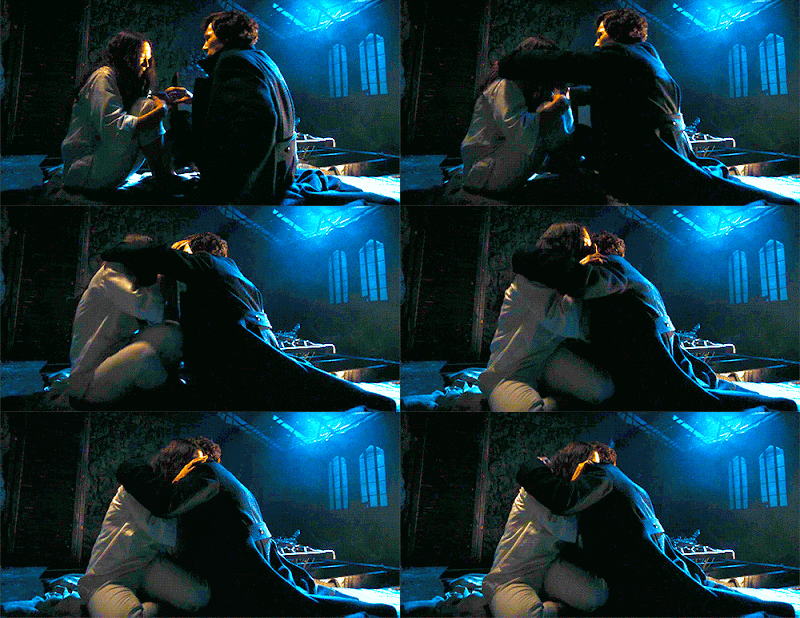

He learned to value his life because of what happened to Mary, he had admitted that he also succumbs to his impulses with Irene Adler (texting or beyond that, depends on what you want to believe), he fully realised that he would never ever want to hurt and make Molly feel like she’s being used by him because she’s his friend, he was able to extend a more human side of himself to John more than he did before, he finally understood and accepted Mycroft’s intentions and actions which I think mended their relationship significantly (this one hits me to the core so much), and lastly, he discovered that if he was left in the air in isolation, he might have ended up like Eurus, which is why he never wanted to make her feel alone again.

To me, it is groundbreaking because it left that cliche of someone running off into the sunset in the end and it’s all butterflies and rainbows. They wrapped it up with the characters still broken, but living through it day by day because someone chose to love, accept, and help them heal despite their flaws.

It is what it is, they keep on saying, because that’s how life is. It can be unbearable and it can most certainly be shit, but in the end, if we all let it, love – self-love, romantic love, familial love, platonic love – all kinds of love, will help us conquer all, within and beyond this show.

theleftpill:

Excellent analysis - and ironically it showcases my main frustration with the series and with Moffat and Gatiss: that it’s all crammed into just three episodes. The character arcs and narrative arcs, and these huge resonant themes, that they present in this series simply need way more time to get from A to X. John’s “cheating” shouldn’t come so abruptly out of the blue. Mary’s death feels rushed and “convenient”. Having Eurus’ entire existence seeded with only one line of dialogue in S3 doesn’t support the weight of her narrative. And I’m aware of “Redbeard” in The Sign of Three and His Last Vow - but those feel more like retroactive “oh lets make it about this instead” than actual foreshadowing. Eurus’ introduction, interaction, and denoument needs to happen throughout a whole series imo, to give it the attention it needs.

I like what you say about Mary’s death though - considerations of fridging aside, because come on we all knew it was coming, it really was necessary for *someone* to actually die, because as fantastical as this show is, at some point you need to ground it in reality. You need to have consequences, and the way these characters play with death, someone had to meet it. Mary is the obvious choice. And I also like what you say about the different “people” we all play in life. I like that Mary chose Mary Watson as the one to live and die as.

I wish we had gotten this played out over two series instead of one - S4 opens so many new avenues into these characters, and directions for them to follow, the themes are so deep and resonant I really wish they could have been explored instead of steamrolled.

vulgarweed:

Agreed about Mary, @theleftpill. While the fridging concept definitely applies because her death was fodder for John and Sherlock’s pain and personal growth, there are also ways in which it didn’t: it actually did come about because of her (past) choices and actions, and she also chose to throw herself in front of that bullet, so she did NOT lack agency. Some people are saying she would have been a stronger character if she had been written as an unredeemable villain. I profoundly 2000% disagree with that. We already have admirably loathsome villains on this show, we certainly did not need Mary to be one - In the close family circle of the show, I prefer morally grey characters, especially ones who start out dark grey and get lighter over time, but never turn to pure white entirely. Especially if they’re women, we don’t get to see enough redemption arcs for Chaotic Neutral women. And when it comes to ordering death, is she really worse than, say, Mycroft just because she’s more willing to look her prey in the eye than he is?

I went through a phase of hating her starting about halfway through His Last Vow, you know the moment. But I also always thought that Sherlock’s forgiveness was guarded but sincere, and he’s the one who gets to make that call, no one else. (Most murders can never be forgiven by definition, because the only person with the true moral authority to do so is dead. But if the victim has a Hollywood miracle and decides that he understands the reason and sympathizes and cares about the person who did it, it can happen.) And I always sincerely believed that Mary and Sherlock really liked each other, so once I got over the recoil, I started shipping Johnlockary pretty hard as a secondary pairing to Johnlock.

I think she did kind of need to die for the story arc, and while I miss her, I’m glad we got a whole episode that was mostly about her and the consequences of her past life. I liked the fact that the “Appointment in Samarra” story really resonated because Sherlock tried so hard to avoid fate - because at least at first he thought it was about him. It wasn’t. The destined meeting with Death that could not be avoided was Mary’s, and in true classic tragedy style, efforts to avoid the fated reckoning only wind up bringing it about by another route.

Also: Sympathizing with and forgiving Mary laid the groundwork for Sherlock being able to sympathize with and forgive Eurus.

I get why a lot of people don’t like forgiveness stories when truly horrible things are involved. But like it or not, that is the kind of story this is. And I do like forgiveness stories, because I’ve done bad things and I sympathize sometimes with those who need it. Forgiveness does NOT mean what the person did is OK. Far from it. It means moving on from that point. And in the cases of both Mary and Eurus, it means saying, “yes, you’ve done truly horrible things, but you are still a human being worthy of love. And I (Sherlock Holmes) am not only capable of love in general, I’m capable of loving you.”

S4 is 100% a story about love. Not romantic love, mostly, (which obviously disappointed a lot of people, but hey, I can easily name 30 fic writers who do romance/erotica better than Moftiss would). But family and friendship love, and agape. It’s a beautiful story, for all its horror-movie silliness (which I also kind of like, because campy horror movies are fun). The more I watch it, the more touching it gets.

You’re absolutely right about the rushing, though, @theleftpill. I feel like a lot of important character interactions got lost because of this. I wanted to know more about John’s feelings about the reveal of the real identity of his bus fling AND his therapist. (I wanted more of John’s thoughts and feelings about lots of things, I feel we kind of lost him as a character for a while there). Lestrade’s reactions. Molly’s reactions.

Friday, 10 March 2017


“Just saving her time. Isn’t that kinder?”
  (Sherlock meta by creamocrop and theleftpill)

creamocrop:

“Just saving her time. Isn’t that kinder?”
— - Sherlock Holmes, The Great Game

Let’s talk about this little quote here.

Sherlock “Mr. Sentiment-Is-A-Chemical-Defect” Holmes thought it was kinder to tell Molly that Jim was gay. Now people always point out that Sherlock always said heart-breaking things to Molly because he wasn’t aware of her feelings for him.

Okay, point taken.

Now, let us fast forward to A Scandal in Belgravia. Personally, it was hard to watch the Christmas scene because it drowned me in the sea of second-hand embarrassment. However, this is the episode where the audience gets to see Sherlock being aware of Molly’s feelings for him.

We saw him stricken by that awareness. He was about to turn away.

It was the perfect time to be “kind” to Molly Hooper.

But what did he do?

He regressed, continued to look down and said “I am sorry.” (Side note, let us appreciate John’s double take because, hey did the world’s only consulting detective just say sorry?) Then, stepped forward, wished her a Merry Christmas using her full name…

…and kissed her.

Yes Sherlock, you were being kind, but not “kinder”. 

Why? It was the perfect opportunity, Mr. Holmes.

Later on, we’d see him saying “Sentiment is a chemical defect found on the losing side”. He was very much aware of this particular sentiment but why did he not take that Christmas scene to save Molly’s time? 

Okay fast forward again to a few frames and there is the morgue scene and for the first time, we see the “egocentric“ Sherlock Holmes, wondering if there is something wrong with him. Of course the whole conversation between him and Mycroft and the fact that he did just identify Irene Adler - the woman to whom he had developed feelings for (what they are, no one truly knows except Sherlock) - as the dead woman could be used as evidence that it was what got him wondering.

But since we are talking about feelings, before finding out about her death, there was one other woman who made him become aware of feelings. I am not saying that it is the reason, but this awareness brought by Molly certainly factored in him finally wondering.

But wait, there’s more.

"All lives end. All hearts are broken. Caring is not an advantage, Sherlock.” 

Mycroft shares this wisdom to his little brother. This tidbit becomes more relevant when Sherlock later says “I’ve always assumed that love is a dangerous disadvantage. Thank you for the final proof.” 

There, the equation is complete. Mr Holmes now has all the proof he needs that being a robot is better.

Now all he has to do is be “kind“ to Molly Hooper!

But he never showed that “kindness”, did he?

The next time we see him and Molly, he was back to being snarky, accusing one of Molly’s boyfriends and telling her not to pursue any romantic relationships for the sake of national security.

This is Sherlock’s brand of kindness - always about other men surrounding Molly, never counting himself in.

He never dealt with it for the whole of series 2.

I’m guessing, he never wanted to. Deep inside, he doesn’t want to save Molly’s time, because it is her time spent on him. 

He does not want to lose that time. 

Remember this line:

“I’d say you better break it off now and save yourself the pain” 

Sherlock said this to Molly after Jim left.

‘Save yourself the pain.’ 

He could have repeated this during the Christmas scene. But no, he said sorry and kissed her.

He could have replied with this line when she said, “Are you okay? Don’t just say you are, because I know what that means—looking sad when you think no one can see you." But instead, he said "You can see me.” 

He could have told her this at the darkened morgue when he told her that he thinks he is going to die. Instead, he said “You.” 

Even, when he just came back from the dead. Even when Molly had finally found Tom, when she is finally wearing a ring and promised to someone else, he can’t even be kind. Instead he says,

“I hope you’ll be very happy, Molly Hooper. You deserve it. After all not all the men you fall for turn out to be sociopaths.” 

Now, this is Sherlock being kind to himself. This is him reminding himself that he is a sociopath and Molly deserves better than that.

This is him saving himself. 

theleftpill:

And I’ll add another small moment to this list (although I’m not sure it has the same resonance as what you’ve pointed out): in the morgue, when Molly arrives at the table Sherlock tells her

“You didn’t have to come in, Molly."

People say that when they feel bad that someone has gone to some lengths to help them, it’s a bit of an apology and acknowledgement of their help and concern all in one. Up to this point, Sherlock’s only MO with Molly has been to use her to get what he wants; here he’s telling her she didn’t have to inconvenience herself on his account, that she should be home enjoying the holidays instead of working for him.

That’s what I’m loving about Molly and her character progression - they’re small moments that are easy to overlook, easy to miss, easy to dismiss. But they’re adding up to something huge. They’re the ones that matter the most.

Sunday, 5 March 2017


A thought about Sherlolly, or: 'Why Molly deserves better' 
 (Sherlock meta by shortwatson and theleftpill)

shortwatson:

Ok, I respect Sherlolly shippers and in a way the two of them would really fit, but let me tell you why I don’t think it should happen in canon. Since episode one Molly is depicted as someone who is hopelessly in love with someone who isn’t really interested in her. She admires Sherlock and tries…


theleftpill:

Correct you if you’re wrong? OK. (BTW I get that you’re focused on Molly’s character, but I’m still gonna correct you.)

Molly is not desperate. She has evolved from the lovestruck mouse you are characterizing her as into a strong independent woman. Sure she still harbors feelings for Sherlock, but in S3 she does it on her own terms. She calls him on his shit with the drugs and demands an apology; she parades around her fiancĂ©, making out with him, having “a lot of sex”; she spends a day solving crimes with him AND THEN TURNS HIM DOWN when he invites her out for food (a HUGE romantic proof in the Johnlock metas). Do you think Blind Banker Molly would have done any of that?

So, accepting that Molly’s character has shown tremendous growth, “getting what she wished for” now takes on a different meaning. Sometimes you are drawn to a person regardless of the “sense” of it; Molly is still drawn to Sherlock. But now if they were to start some kind of relationship, it would be largely on her terms. How do I know this? Because they’re already there, throughout series 3. Keep in mind Sherlock has also undergone tremendous emotional growth, and no longer treats Molly as callously as he has in the past. Their relationship has already fundamentally changed, toward a more healthy connection on both sides. The romance you are envisioning is no longer possible.

I fail to see how a secondary character ending up with another secondary character would be “the very top of character development.” Stronger development would be a secondary character who is afraid of her own shadow growing into a powerful person in her own right, and a primary character finally allowing himself not only to show but also to actually feel the feelings he’s harbored for so long, and for the two of them to find each other and develop those directions even further.

“She would have evolved from the desperate girl she was to a women who knows what she wants and knows when to let go of the things that only bring you down.” She already has (see: Sherlock series 3.)

“So I basically just think that Molly deserves better than just being Sherlock’s final love interest (what she’d most probably become degraded to) She’s just too lovely and has too much potential as a character to end like that.”

What makes you think being a love interest means a character’s end?


Why watch Sherlock? 
(Sherlock meta by shylocks and theleftpill)
shylocks:

I’m just so confused about people that watch Sherlock and don’t care about the relationship between Sherlock and John? That’s what the show is about? What do you watch for the cases? Sherlock Holmes has never been about the cases and in [s3] we had what 2 decent complete cases in the entire last season? You watch for the 3 minutes of Molly and Lestrade? What?
"It's about the two of them. The whole way this show is written, shot; everything is about the two of them."
                - Martin Freeman in Unlocking Sherlock
 theleftpill:

The show is about Sherlock growing up and gaining his humanity. His relationship with John is the major force of that - but not the only one. That’s where the change starts (his rescue of John even as John rescues him), but as he matures, that extends to other people. His extended family - and I don’t think anyone will disagree that they all are a family - become a stronger part of that as he (and the story) progresses. So that’s the story angle.

From the production angle, as the show itself progresses the secondary characters are given more time to play. They gain a more vital role in the main story that enriches not only the main character but also the narrative itself. You need to flesh out other characters to keep the story fresh; that makes for a better show that more people want to watch. I would [love] to know Mrs. Hudson’s exotic dancing backstory. She’s a perfect example: you get a quick hint in the very first episode with her “herbal soothers” that there’s more under the surface with her, while the story is focused on John & Sherlock coming together. Now that their relationship is established, she serves to push the narrative even further with her stories about her wedding and her husband’s criminal past. Think how empty the moment Sherlock leaves the wedding would be if we didn’t have her context. Secondary characters allow the main ones to tell a better story, and when they’re written and performed at this level are a joy unto themselves. Mycroft I adore without reservation. If the show was only Sherlock/John we wouldn’t have all his deliciousness.

Rich, complex secondary characters make the show much more compelling to watch and one of the reasons Sherlock is such a good show. Watching these characters play off each other is sheer delight. Other reasons I watch that have nothing to do with Johnlock: the whip-smart writing and comedy; the amazing editing; the breathtaking cinematography; the twists and turns within the cases; Moriarty’s insanity; the “modernization” and twisting of the canon stories; Mycroft and Sherlock’s growing relationship; watching a damaged, vicious, frail human being become “a good man.”

So you’re welcome to watch the show through such a narrow focus and enjoy it that way; I prefer to wallow in the whole. There’s so much more to enjoy.

(And yes, Sherlock has always been about the cases, don’t know where you’re getting that from.)


Wrong opinion about Molly
 (Sherlock meta by sherlollysnog and theleftpill)

sherlollysnog:

Fellow Sherlolly shippers and Molly Hooper lovers, I was wondering if I could get some help. Someone I know posted this about Molly-
“Molly hooper doesn’t do much of anything but whine about Sherlock not loving her back. And I don’t blame him. She’s BORING and a needy bitch. I’m just saying, I won’t be crying if Molly gets thrown in a woodchipper or something.” 
It’s 4am and I want to defend Molly but I’m tired and I can’t quite put in to words to this person to explain how wrong she is and I was wondering if someone could help me out?

theleftpill:

Well, first off, your friend is flat-out incorrect. I can’t think of any single scene - not even any line or moment - where Molly complains that Sherlock doesn’t love her. She accepts his rejections with “OK” and leaves; asks if he’s got a girlfriend; calls him out when he insults her. Yes she’s nervous, skittish, mournful and frustrated, but never once does she complain he doesn’t return her affections. In fact, quite the opposite; when faced with his emotional bullying she stands up even taller, looks him in the eye and does not once back down. The only times she complains is when he’s a shit to her. Rather justified, I think.

As far as boring, I disagree. She’s quiet, yes, and meek, but consider how her character has moved some major plot points forward. She introduced Sherlock (and us) to Moriarty. She helped Sherlock fake his death. Sherlock’s idea of her, his projection of her, helped to save Sherlock’s life. Molly has been the sole catalyst for some of Sherlock’s biggest moments of emotional growth. She very publicly reprimanded him for his “deduction” of her which compelled him to apologize without demanding it. Her “You look sad when he cant see you” pushes him to recognize his affections for John, and arguably even his capability for affection. Not very boring, in my book.

But while all of this directly proves that your friend’s point is factually incorrect, none of this will convince her. Because as Petra points out, she doesn’t want to know. She’s not looking for information or debate; she’s pushing buttons and looking for reactions. That’s all. It’s a waste of time to argue with someone like that. Publicly sharing your defense of Molly may sway some others reading this thread, but it’ll do fuck all for that person. And what does it matter anyway? Her view shouldn’t affect yours (since it’s completely groundless.) I wouldn’t be crying if she gets thrown in a woodchipper or something.


Mary's Attitude in The Christmas Forgiveness Scene 
 (Sherlock meta by incurablylazydeviltheoklahomos and theleftpill)

incurablylazydevil:

 How do people watch that ‘oooh we’re doing conversation today it really is christmas’ scene and go ‘look how sweet and snarky Mary is, what a nice character’ while i’m sitting here trying to calm down my gag reflex?

theoklahomos:

SAME it’s like bitch you killed literally the most important person in your husband’s life and that was just the cherry atop the massive shit sundae you’ve served him up and now - now! - you have the nerve to act like HE’S being unreasonable for not having spoken to your bitch ass for a few months what the actual fuck Mary is horrible!

theleftpill:

I hold the opinion that people who react this way to the Christmas/Forgiveness scene have never been in a mature, respectful relationship. Those who have understand that 1. she’s not sweet and snarky - she’s scared and frustrated, and 2. because she might very well have reason to “act like HE’S being unreasonable”. The way they interact with each other tells us a great deal about what’s happened in the last few months without actually seeing it. “We’re doing conversation today?”: how many times has Mary tried to talk to John, to make things right, to correct the mistakes she’s made, and John has completely shut her down? “Months of silence, and we’re gonna do this now?” Her frustration and anger radiate off the screen; this is something she’s tried to work out before and has been completely rejected, but instead gets ambushed at a strangers’ home by her silent husband. Wouldn’t you be a little pissed off?

We have no idea what John has put Mary through for the last few months. We do know John has a nasty temper and we know he’s a complete dickhead sometimes. So maybe Mary has a reason to be snarky and angry and in pain and flat-out terrified when her husband finally approaches her. Yes she shot Sherlock but this moment isn’t about him; it’s about their relationship. About her secrets and his forgiveness. And yes, in a healthy relationship, it is possible to forgive.

Things aren’t so fanfic-black-and-white when you’re dealing with another real-life person. Sometimes you don’t like the person you’re in love with. Your partner can get angry, can get sad, can get frustrated with you and in a healthy relationship, you realize that maybe they have a reason to feel that way. John & Mary embody this dynamic beautifully in this scene, and it’s one of the reasons I love it so much, how utterly real their relationship is, and how much is revealed about their relationship in their exchanges. In this moment, I don’t see Mary as “nice”; I see her terrified. I see her protecting her heart by being defensive and sharp. And in a real relationship, that’s allowed.

And that complexity makes me curious to see what happens next.


Sherlock is fully aware of Molly's feelings for him 
 (Sherlock meta by mizjoelybassfanimation and theleftpill

mizjoely:

“After all not all the men you fall for turn out to be sociopaths.”

Why are none of us talking about the fact that this line shows definitively that Sherlock is fully aware of Molly’s feelings for him?? He defines himself as a sociopath, so he’s obviously talking about himself (or at least including himself in a select group of men) - ipso facto, he knows how Molly feels about him.

Guh. I will never be able to write a post S3 story where he’s oblivious of her feelings!

bassfanimation:

I’ve always thought of Sherlock as being very aware that Molly has feelings for him. I think the Christmas scene sealed it for them both. Unfortunately, it also forced them both to acknowledge that it was “impossible” for them to be together. Neither of them let the feelings be forgotten, but they both have had to compartmentalize it and try to ignore it. Sherlock can’t love, or at least he doesn’t want to love. We may never know why according to Moffat’s universe. Molly sadly accepts that because she doesn’t want to change him, even if it means he’ll never return her feelings. I like to think this is something Sherlock truly does love Molly for. She would rather love him from afar than to make him change for her, in any way, shape, or form. Him knowing that he has the love of someone is something he cherishes, even though he would never tell a soul.

theleftpill:

Oh yes, Sherlock knows exactly how Molly feels for him - evident in their first exchange: when Sherlock asks her about her lipstick after beating the corpse, his gaze lingers on her with a knowing expression. He knows exactly what’s up. Where I find the progression is in Sherlock’s reaction to that sentiment. S1 has him using it to his advantage, to utilize her and manipulate her to do his bidding - that is, when he wasn’t dismissing it. That starts to change when Sherlock calls out her “boyfriend” as gay and upsets her; he’s surprised by her pain and crestfallen. The Christmas party is the turn for me. Not only does he fully realize the extent of her love for him, but he reacts strongly in return. Not in love, not yet, but enough regret and affection that Sherlock apologizes for being an ass to her. Then he goes to her for help with the Fall - not to manipulate it from her, but because he accepts her affection and embraces what is freely given. In S3 he begins to return it in Sherlock-y ways; inviting her to solve crimes, bringing her further into the “circle” (engagement party), asking her to help with the stag night; and ultimately he has her in his head, literally, saving his life once again. While I’m not sure that returning her love is yet canon, there’s certainly plenty of fodder that proves he not only knows of her feeling, but returns it as best he can in the ways he knows how.


She can’t sit there 
 (Sherlock Meta by sherlockmetafkef.tumblr and theleftpill)

sherlockmeta:

So, I haven’t seen anyone mention that in His Last Vow, when John sees that Sherlock has moved his chair–doesn’t it seem like that was another adjustment Sherlock had made as part of his ruse relationship with Janine?

He went to all the trouble to allow her into his living area, and let her be physically close to him (to an extent)…but the one thing he couldn’t bear was to have her sitting in John’s chair. Because moving it to his own bedroom wouldn’t have kept it out of Janine’s way, I assume he carried it all the way upstairs to John’s old bedroom, to ensure it wouldn’t be violated. Lugging a bulky armchair up a staircase, by himself…quite a bit of effort to go to, and not the type of thing I see Sherlock doing if he’s simply trying to cut John’s place out of the flat in retaliation for his marriage.

No. His relationship with Janine was an elaborate performance, requiring sacrifices of his personal comfort in order to play the role to the hilt…but he was, in the end, unable to countenance the thought of allowing Janine to sit across from him, in the space that was rightfully John’s. And as soon as he’d got Janine out of the way, he immediately brought the chair back…

theleftpill:

It’s possible that this was Sherlock’s motivation, but by making Janine the reason he lost the chair and her absence the reason he brought it back, you lose not only a pretty big plot point but also the stronger symbolism connected to John’s absence and return.

John’s missing chair is a lovely physical, non-verbal, passive-aggressive, pity-party tantrum of a metaphor. Sherlock Removed The Chair. And then he didn’t re-arrange the furniture to balance out the room, he didn’t shift things around to better utilize his living space; he left a huge gaping hole in the middle of the floor. One you can’t possibly hope to miss. And when called on it, he gives such a lovely bullshit response. The removal is used as another metaphor for Sherlock’s inability to cope with John’s absence.

The chair returns to signal John’s “beginning of the end” of his trust in Mary. It’s Sherlock’s way to break the news gently to John that he’s soon to move back in, along with the perfume bottle working as the clue as to why. The chair’s return communicates that Sherlock is prepared to take John back, that John is welcome back, and neither of them have to discuss it. The trust and support is inherent and explicit. You know how these men hate to directly address all this touchy-feely stuff. It works beautifully.

If Janine is Sherlock’s motivation for losing the chair, you lose all of that metaphor. It’s not gone because of Sherlock’s pain; it doesn’t return because of Mary’s betrayal; it comes and goes because of the presence of this woman (whom Sherlock invited into his home, as the OP points out.) The chair then signifies John only peripherally. Janine also is made into a stronger force than John. Sherlock can cope with the empty chair: “Yes the chair brings fond/painful memories, but I can experience them and move on.” But put Janine in it: “But when this harpy comes in and tries to sit down well we need to put a stop to that. Sore feet is what she deserves.” This idea raises Janine’s emotional importance to Sherlock above John’s, and that’s just not this show.

It further reduces the gesture to an act of hostility towards a woman he’s using for a purpose. Sherlock is rarely (ever?) hostile without a reason - either manipulation to get what he wants or emotional retaliation. He has no reason to be vicious to Janine; she’s there because he wants her to be and he genuinely likes her. The chair’s return furthers the petty motivation and discards its use to forward the plot; it wasn’t there to tell John gently that he’s soon to move back in, it was already there for some other reason and John sat in it out of habit.

Sherlock’s inability to bear Janine in John’s chair can’t be the reason Sherlock lost it, if you want to keep the symbolism of the loss of John and how it works in the plot. It is a nice headcanon layer though.

And don’t forget that if she doesn’t have a chair to sit in, then she’s forced to sit in Sherlock’s lap. And that’s a bonus he probably didn’t mind having.

fkef:

I always find it incredibly interesting that people forget that Sherlock used Janine. And didn’t let her know what was up. Because he didn’t trust her. No, he didn’t like her. We saw his fake smile fall as soon as she left the apartment. Do we just all see Sherlock let a woman sit in his lap and all go, [OMG Sherlock in love]?

Jesus christ. I don’t think Sherlock liked her. He knew from the start that she was of use to him, and so he carefully nurtured that relationship. If Sherlock knew of Mary’s ex-boyfriend before meeting him, what makes you think he didn’t know where Janine worked before meeting her?

Sherlock calls himself a high-functioning sociopath (and we see that it’s pretty true until we meet Redbeard), and that means he manipulates people; he uses people. People are means to his ends (which, because he’s on the side of the angels, are “good” according to us).

The chair has nothing to do with Janine and everything to do with John. Janine was simply a key to Magnussen’s office.

theleftpill:

Of course he wasn’t in love with her; he was absolutely manipulating her by staging that “relationship.”  But that doesn’t exclude him liking her.  It’s most succinctly shown in their delicious “So we’re good?  Of course” moment.  That moment is genuine camaraderie; he respects her and enjoys her company.  The Sign of Three is rife with great Sherlock/Janine moments.  I mean jeez, the guy spends the whole day trying to find her a guy she can hook up with.  This is Sherlock; why in the hell would he waste his time like that on someone he doesn’t like?  He confesses his love of dancing to her.  He searches her out to dance with.  Yeah, Sherlock likes Janine.  It’s all in the show.

I don’t think he “knew from the start that she was of use to him.”  Until His Last Vow, Magnussen wasn’t on his radar: it was Lady Smallwood’s request of Sherlock to be a go-between that motivates his cultivation of their “relationship.”  It was a “stroke of luck” that she happened to be the maid of honor (as far as Sherlock knew at the time.)

Sherlock knew about Mary’s ex because he’s seen the guy’s tweets and cropped Facebook pictures, because Sherlock is friends with Mary and he notices these things.  Not because he’s been researching random people in the hopes that they someday might have use in a case.

Sherlock calls himself a sociopath. Sherlock is a crap sociopath. (I have a great gif set idea for this; anyone know how to build those?) We see it’s pretty not true; hugging and kissing Mrs. Hudson, revenging Mrs. Hudson, showing true remorse and apologizing to Molly, do I really need to list the proofs with John to you? Sure he manipulates people.  He also is capable of liking them and having friendly relationships with them. One of the great dichotomies of his character is that he does both at the same time to the same person. Sherlock is a complete shit to the people he loves.  I love that complexity.

So I’m sorry if it upsets you, but Janine is truly and canonically more than simply a key to Magnussen’s office. She caught Sherlock’s attention. She earned his respect. You can’t reduce that richness of character to a mere prop. (Well, you can and did, but that doesn’t make it accurate.)


Why Molly and Not John?
 (Sherlock meta by theleftpill)

An anon asked Petratodd if she thought Sherlolly would ever become canon. This is something I’ve been mulling over since my my third full viewing of S3. I’m a professional editor for film/TV and spend most of my job working with story structure, character development, and how to best reveal the plot. From this point of view, I think the writers are pointing to a romantic attachment between Sherlock and Molly in both the plot points and character development. While I’ll be really surprised if it becomes a major storyline, or is ever happily resolved, I think it’s definitely headed in that direction.

Sherlock goes to Molly to save his life. Twice. Even his subconscious goes to Molly, the first person he trusts. She’s the person he depends on for his life, the person he can trust without limits. “The one who mattered the most.” When John refuses to be available after the return (both emotionally, and physically for cases), Sherlock turns to Molly. He wants to “solve crimes” with her. Molly’s the one who runs his urine test (ew) and calls him on the carpet for his stupidity. She’s becoming very physically involved in the story, even when they could use a different character.

He could have gone to John to save his life. John is an army doctor. He has extensive knowledge on how to survive a gunshot wound. Sherlock knows this. John could easily have been used to talk him through the fall. Sherlock could have let John in on Lazarus; there are many scenarios where John could have been prevented from “letting the cat out of the bag”, or they could have just not used John’s inability to lie as a plot point. It makes narrative sense for John to be the one to help save his life both times, but that’s not who Sherlock goes to. He goes to Molly.

Sherlock allows himself to be vulnerable to Molly. Twice. Three times actually. The Reichenbach request, in his Mind Palace/subconscious, and in The Empty Hearse when he thanks her for helping him. This vulnerability is a huge move forward in Sherlock’s character development; asking for help, placing trust and giving sincere thanks were things that just did not happen in S1 and most of S2. Sherlock is growing and the writers are using Molly to facilitate it.

(Oh wait - four! Four times Sherlock was vulnerable - the Christmas present! Fuck! They really are setting this up!)

He could have gone to John. John and Sherlock adore each other. It’s no secret. They love each other and have said so - Sherlock in public. But Sherlock has never been vulnerable to him before (the closest he’s come is the “apology” in The Hounds of Baskerville and that’s debatable.) It would make narrative sense, and more importantly, demonstrate tremendous character growth to be that vulnerable to John. But he didn’t. He’s vulnerable to Molly.

Now. Why would they use Molly for all that? John is one of the main characters on the show and ACD canon, and his character has been established enough that you could replace Molly with him in any of those scenes. But the writers didn’t use him, they used Molly. Why would they use a secondary character? She isn’t in the ACD canon, so they are not beholden to any canon story line involving her. Why spend so much time on her?

Because they are making Molly IM. POR. TANT.

Screen time in a TV show is very important. You want to use only the elements that are crucial to your story because you have only so much time to tell it. Good storytelling includes setting up your later plot points earlier in the story so it leads to a natural and satisfying conclusion. If you don’t have those seeds early on, your story ends up feeling fake and your audience will cry bullshit. So you want to put elements in the start of your story that will become important later on.

I have this issue in my current show. I have a big revelation in the last act of the show that is set up beautifully in the first act of the show. Unfortunately, I have 39 minutes to tell this story (yes, an hour show is only 39 minutes long) and there is more important content than this, so I won’t have time to play the earlier scene. So now the big revelation is going to come out of the blue and feel fake, disingenuous. “Sherlock” has only 4 hours 30 minutes to tell a story which could reasonably be three times that. The writers aren’t going to waste screen time on plot or character that doesn’t serve some sort of purpose. So I ask again, why use Molly to further Sherlock’s character in such crucial, momentous ways?

I think these and just about every other Molly scene is setting up for a stronger emotional attachment and certainly a strong role for Molly in the show. My conjecture is that Sherlock will fall in love with her, as far as he is capable. I said in my earlier post that she will be a “love interest”; there are many levels to that and many directions it can be taken. I don’t think it will ever be consummated, because there goes your conflict (see: Moonlighting), and Sherlock is canonically a bachelor, but I do think that’s the direction the story is pointing.

But wait! you cry. Sherlock is gay! He admitted it to Janine and because the Mind Palace courtroom is red! (Both of which are bullshit and merit their own post.) So he can’t end up with Molly! Well, not so much. The Sign of Three pretty clearly tracks Sherlock’s growing attraction - yes, attraction - to Janine. The wedding starts with him noncommittal to her presence, and ends with him hopefully seeking her out to dance with. (Again, this could be its own post, and probably will be.) According to this narrative, Sherlock is either straight or bi, both doors opened wide to an emotional interest in Molly. Again, sowing the seeds for a later narrative.

Whether or not you take this to prove “Sherlolly will be canon” is up to you, because I’m not trying to prove that either way. This is what I see in the show, combined with my professional experience, and it leads me to believe that Molly is being set up for a romantic attachment to Sherlock. Don’t know if it will actually happen. Only Moftiss know for sure.

Friday, 3 March 2017


Two good friends who have been through all sorts of shit together who just need to say 'I Love You'...
 (Sherlock meta by theleftpill)

Q: [Eurus] sits back and watches them both go completely bonkers. Literally fall apart over something as simple as saying 'I love you'. Two good friends who have been through all sorts of shit together who just need to say 'I love you' – for a case, for a game, for a dare. I mean, how difficult should that be? Well. If there were no complications, it would be simple and quick. But things have become quite complicated with those two under their facade of "You're my friend. We're friends". All Eurus in fact [has] done is metaphorically put these two people in a room together and put before them the word 'love'. And they both go completely bezerk, completely lose it. And in the process, the facades come crashing down. And when I saw Sherlock on the floor, with his back to the wall, still shaking with all the shards around him. -those shards, that's his facade in pieces right there. Not clumsy at all, Eurus, not clumsy at al.

A: [...] I am in complete agreeance - the very existence of the struggle from both of them proves “ILY” is legit. I mean, it’s no surprise from Molly, but Sherlock should have breezed his part, right? And I love your parallel of the coffin being his facade. What I love about that moment is its complexity: he’s destroying his facade, he’s raging against his entrapment and manipulation, he’s punishing himself for hurting Molly - and how does he feel about all that??? I don’t get the feeling that the rampage is entirely controlled or deliberate; Sherlock doesn’t go off like that. He doesn’t even know what he’s feeling or why he’s doing it.

But you’re right - making these two finally face what’s really going on between them was hugely destructive in the best way. If nothing else makes Sherlolly canon, this does:

Two good friends who have been through all sorts of shit together who just need to say I love you – for a case, for a game, for a dare. I mean, how difficult should that be? 
If there were no complications, it would be simple and quick. 

Nailed it.

Thursday, 2 March 2017


Molly Hooper: Attributes vs. Actions 
(Sherlock meta by jengi-tumbltheleftpill and likingthistoomuch)

jengi-tumbl:

One thing I’ve noticed about Molly Hooper that stands out from all the other characters in Sherlock is her response to the times when Sherlock is unfeeling, inappropriate, or just truly being a jerk.

 She calls out his actions. She never attacks him. 

Not once do you hear Molly say something along the lines of “Sherlock, you’re a terrible person” or one of the many name-calling options John has employed to describe Sherlock (ex: smart-arse, etc.) And not only John, but others who have decided to rip into Sherlock with insults as well, even if some of them (like most of John’s, I would argue) aren’t meant to be truly derogatory (ex: freak, bastard, psychopath, dick/dickhead, stupid, etc.)

There were so many times when Molly could have lashed out at him as a person, but even in her most heated moments, she chooses to call out his actions.

The Great Game: “He’s not gay! Why do you always have to spoil- He’s not!” 

A Scandal in Belgravia: “You always say such horrible things… every time…” * 

His Last Vow: “How dare you throw away the beautiful gifts you were born with… And how dare you betray the love of your friends!” 

(I guess you could technically argue that she does attack him here with the slaps, [...] but that’s besides the point I’m trying to make.)

I find it so interesting because there is a power in calling someone out on what they do rather than who they are. In general, if someone is perpetually called freak, bastard, dick, sociopath, they start to believe it. And if they believe it, they take it on as part of their identity.

Molly steps in and breaks this pattern. She sees Sherlock, the real Sherlock, deeply, and in a way no one else has been able to before. Her responses echo a quote from one of my favorite books, Grace for the Good Girl by Emily P. Freeman:

“You’re not this way. This may be how you cope, but this is not who you are.” 

I believe this is partially why Sherlock considers Molly such a safe place (or a bolt-hole, if you will…) She’s a place of comfort, safety, and rest, even if he doesn’t realize it. The person who loves him because of, and in spite of all he really is. The one who believes in him.

Just an observation.

Also, they need to be together. Like, yesterday.

—————

*(When I first watched A Scandal in Belgravia, oh my gosh, this scene was wonderful because Molly could have just called Sherlock all kinds of nasty names, but she chose those words instead. Ugh, love it. So powerful. It’s when I thought, “Oh she’s different. This girl is gonna be a game-changer.”)

theleftpill

Brilliant point - and so crucial for her character. I was surprised (and thrilled) also by the ASiB moment for a different reason though - I expected her to break down (in tears/frustration/anger) and instead she stands with head held high and directly calls him on his shit. But that shouldn’t have surprised me, precisely because of what jengi-tumbl so wisely points out. Her strength was always there - and I didn’t recognize it. So many of us didn’t.

But Sherlock did.

I’ll never understand why/how people can dismiss Molly Hooper. She’s a total Emotional BAMF.

likingthistoomuch:

So well put. Molly’s strength was always in seeing as well as observing, she saw Sherlock as a whole and observed his actions, calling out on them when they became hurtful. She always held her head high, always knew where she stood and has always been such a BAMF.

Thursday, 23 February 2017


It’s interesting to note that… (Regarding Sherlock's type)
 (Sherlock meta by justaminionmychakk and theleftpill)

justaminion:

When Eurus wanted John’s attention, she impersonated a vivacious, confident woman who found him attractive.


When Eurus wanted Sherlock’s attention, she impersonated a slightly awkward, pretty, but vulnerable woman who needed him to save her.


What, therefore, might we deduce about Sherlock’s “type?”


mychakk:

Wow, that’s a pretty interesting observation. Meta bunnies attack, sorry, they make my hijack this post….

Notice that the description of the woman Eurus impersonated for John fits Mary exactly to the bone. She was John’s type through and through. Warstan <3

Also, which other woman on the show fits that description? A certain Dominatrix. But instead of John, she finds Sherlock being attractive. And since John wants Sherlock to be happy, what does he do? He shoves Sherlock toward her. In John’s mind it’s a perfect match, but in reality, it’s him himself who subconsciously finds her attractive. He’s projecting his own type onto Sherlock when he thinks of his best friend in a relationship with a woman. That’s why John’s first thought is Irene when he makes his speech in TLD, why he thinks of her first when they deduce the coffin. She’s [...] John’s type. It’s also why, Molly never crosses John’s mind.

For all his consideration, John has never found Molly attractive, she’s too stammering and stuttering, too eager to please, too shy for his liking. He’s always dismissing her importance, because subconsciously she’s not the type of woman worth his noticing. It may sound harsh, but it’s simple rules of attractions I suppose. And, like I said, John has never been attracted to Molly that way. Well, except that one Christmas, when Molly dolled herself up projecting false confidence. Both John and Lestrade drolled over her while it was the only time Sherlock openly disliked what he saw regarding Molly. Because the thing is, that’s not what Sherlock actually finds attractive.

I’m probably in the very minority of our fandom, but I’ve never seen any attraction toward Irene on Sherlock’s part. That’s was my very first impression when I watched ASiB, then I went online and was bombarded with all the Adl0ck stuff, even in the Sherlolly stories/posts and it made me start doubting myself. Must have missed something, I thought. It took me a while to rewatch ASiB, as I needed to brace myself for all the supposed Adl0ck there, and surprise, surprise, my first impression was only confirmed on my second and third viewing.

I will never deny that Sherlock was very intrigued by Irene and fascinated by her intelligence, brainy is the new sexy indeed, but she was intriguing only as a case. She’s not his type, so while it stroked his ego, her obvious attraction to him, he wasn’t moved that much by it. I do think that by the end of the episode, he was seriously entertaining the thought of giving it a go with her, but then she showed him her cards when they met in the plane - she had ruthlessly played him in order to get to Mycroft for Moriarty.

I think in this moment Irene herself destroyed any future possibilities for Adl0ck. Her betrayal was like a bucket of cold water that allowed Sherlock to crack her pass code. She was a worthy and capable, not-to-be-underestimated adversary and having her in his corner owing him her life was too much an opportunity to pass up, so he saved her in Pakistan. Plus, no matter what, he’s a caring man, and she was vulnerable and in need of being saved.

Do I think they did the deed in Karachi? No. He denied her once again. She betrayed his trust, and trust is something he values very much. Was it hard for him to turn her down? Definitely. Like I said, she was vulnerable and in need of being saved, and that IS his type.

Now what is really Sherlock’s type? A slightly awkward, pretty, vulnerable woman who needs him to save her. But that’s only the surface. Notice, that Eurus impersonated a woman with morals stronger than family bonds, a woman strong enough to do what’s right no matter the cost and consequences for her (she was supposedly betraying her own father). That takes courage, inner strength, and determination. And that’s even more attractive to Sherlock than the initial description.

We all know who fits that bill. Molly. Time and time again she has proved to him her strength, resilience, her determination. She has stood by him, catered to him, but has never been afraid to stand up to him, even back in season 1 she called him on his behaviour when Jim was introduced. Even back then she was quite determined in asking him out. And courageous. On top of that she’s awkward and pretty. And yes, Sherlock has always found Molly pretty – you do not notice lipsticks, pounds gaining, breasts, etc, just because. And even if you do, you do not point it out loud. Sherlock finds Molly physically attractive, her character traits are also ones he values much (those can also be applied to John, Lestrade, Mrs. H), and she’s the most trustworthy person he knows. And this is the final seal on the deal.

I mentioned above that trust is something Sherlock values very much if not even the highest. Irene destroyed any possibilities for any future Adl0ck by betraying Sherlock’s trust. And I think Sherlock is incapable of being intimate with someone he cannot trust. Molly on the other hand is someone who saved him, his friends, and maybe even England. Molly took all in stride and for two years harboured his secret. Molly welcomes him at Barts trusting him with her work place, welcomes him at her own home, trusting him with her private life. And Sherlock trusts her in return, with his life, with his plans, with his vulnerability. It’s canon he trust her more than he does even John.

Molly’s always been his type, Molly's always been the one.

theleftpill:

I disagree with your take on Adl0ck - while I do agree that the attraction isn’t an emotional one, I do think Sherlock is physically and definitely intellectually attracted to her. My pov is that Irene opens the door to the possibility of connection and attachment for him; she’s a safe person to experiment with, to indulge with, because there are no stakes attached. I agree that she’s destroyed any trust he could have in her, but that wouldn’t preclude him from exploring the involvement. (And I don’t feel Irene has a problem with this.) She definitely echoes for him - appearing in his mind palace, the picture in the Victorian watch, still texting after all these years. There is something there that can’t be dismissed.

But your observation about John is a revelation - yes, [...] I completely see Mary in Elizabeth. But wow, John - It makes perfect sense that John would encourage Sherlock to go after a woman he felt was attractive. And why he doesn’t see Molly.

But Sherlock does. You’ve nailed that completely.

mychakk:

It’s fine to disagree, I know I’m in minority on this Also formulating reply clarifies my own views. I definitely see your point, especially if your take on Sherlock is that he can be intimate without a shared trust. I can’t. And I just realized it ties up with my view of him being unable to find himself worthy of love in any form. I explained this in one of my earlier posts, just don’t know how to link it here yet… But I definitely agree with you about Irene opening Sherlock to a possibility - I also wrote that in the post I cannot link here. But to me Irene opened Sherlock to the possibility of being attractive to someone the way he is (brilliant, passionate, driven etc, not just for his looks), she finally managed to convince him, and then she betrayed him. (Also Molly does exactly the same thing in her quiet unassuming way - she shows her attraction to him, except she doesn’t betray him, and later on in The Reichenbach Fall she proves to be trustworthy like no one else). I think that Irene is a double edged sword in Sherlock’s Mind Palace - on one hand she represents a captivating woman being attracted to him, his indulgence in being attractive to someone (The Sign of Three) on the other hand she’s a harsh reminder of sentiment being a disadvantage that can kill you (the locket in The Abominable Bride). But that’s me. The best part in fandom is we can have different opinions.

justaminion:

I’m so glad my little post helped start this insightful discussion! (and that people can disagree so politely, Sherlollians are the best).

I like the Steven Moffat quote about Sherlock and Irene’s idea of a night of passion being to meet up every so often to rescue the other one and then run off again.

Regarding intimacy and trust, I agree with you. I think it’s interesting that the “I don’t count scene” with Molly demonstrates that Sherlock already lets Molly see his vulnerabilities, which he hides even from John. He doesn’t make the conscious decision to trust her, he just does.

Tuesday, 21 February 2017


A small Sherlock and Molly moment that get instantly forgotten
 (Sherlock meta by theleftpill)


Consider, Sherlollians

Everyone makes a big deal over “Jim from IT’s” scene in The Great Game, and Sherlock’s deduction and why he makes that deduction and Molly’s reaction to the deduction and Sherlock’s reaction to Molly’s reaction. But all that distracts us from the very start of the scene, when Molly enters the room:

Molly: Any luck?
Sherlock: Oh YES.

Consider:

Molly has just intruded on Sherlock and John’s conversation about The Work. She has broken in, she has interrupted. Sherlock, however, does not respond with annoyance, he does not “humor” her question, he does not ignore her or shut her down.

He responds enthusiastically. Molly walks in, and Sherlock’s happy about that.

Sherlock welcomes Molly in, he’s already engaging with her, he’s excited that he has a result and is ready and dare I say eager to share it with her. This small moment speaks volumes. This small moment shows us - in two lines of dialogue that get instantly forgotten - that they are colleagues, that Sherlock respects her work, that Sherlock relies on her assistance. That Sherlock enjoys her presence and wants to work with her.

They’re both getting ready to do some down and dirty Science. And we’re gonna get to watch!!! And then look who shows up:


DAMMIT, JIM.

And the whole thing collapses like a flan in a cupboard.

Thursday, 16 February 2017


Let us never forget a very simple, very textual fact
 (Sherlock meta by theleftpill)

Anonymous: Let us never forget a very simple, very textual fact. After remaining composed upon learning he had a psychotic sister, after watching 5 people die a senseless death, after 4 seasons of mostly managing to remain composed and focused in the face of death, danger and betrayal, our haughty, superior hero needed to be calmed down by others FOUR times within the span of a just few minutes because of Molly. All three people witnessing his call to Molly had to intervene to calm him down at some point.  

theleftpillWhat was the word he used to describe the experience? Oh yes - “vivisection.” Being flayed alive. He didn’t say that when he was forced to shoot John or shoot Mycroft; it wasn’t vivisection when forced to choose between murdering his friend or his brother. It was vivisection when forced to reveal his feeling for Molly. 

And keep in mind the basic storytelling element of escalation: the conflict gets bigger the further you go. The ultimate horror would be Sherlock killing himself. The next worst horror would be Sherlock murdering his friend, then his brother. Where does Molly fall in the arc? Right near the top. It’s not the first test, it’s not even in the middle. It’s the second most horrific test Sherlock could be made to face, and it’s the one that breaks him. 

Tell me again how “I love you” was all just a lie.

Wednesday, 8 February 2017


Why did Eurus flirt with John?
 (Sherlock meta by theleftpill and anarfea)

Q: Hi! Why do you think Eurus flirted with John? I mean... if she wanted to know more about him or his relationship with Sherlock she just needed to read John's blog, right?

theleftpill:

I don’t know, really. I haven’t let myself delve too much into Eurus’ storyline, because I’m not really resolved to embrace it yet. (I’m not really a fan of the retconning required.) But to explore it a bit -

Reading the blog gets you only so far in knowing John. It’s clear that there’s a lot that John is leaving out: whether out of privacy or laziness or forgetfulness, the blog entries are not the whole picture. And when you’re writing for an audience, you write with a “persona”, you present a picture of yourself to the world which may not be entirely genuine. You don’t see interactions, body language, emotion, etc. So reading the blog wouldn’t necessarily give Eurus a complete picture of John, or his relationship with Sherlock.

A big question about why she flirted with John is WHY? Was she trying to understand him, and for his own sake or Sherlock’s? Was she looking for material for her game? Did she just want to know her brother’s best friend? Was she testing his loyalty in his marriage? I think this is one of the major elements that suffered in (my imagined) compression of the stories into S4. As it stands now, for me, the flirting has no reason, doesn’t really go anywhere (except to make John guilty), and just serves no purpose. At least to my mind.

I’d like to hear others’ opinions on this - I know a lot of you have been exploring Eurus’ storyline and motivations a lot more than I have. Thoughts?

anarfea:

@drinkingcocoa-tpp had an excellent answer to this question on the most recent episode of 3 Patch Podcast during the S4 reaction roundtable. In a nutshell, Eurus understands that Sherlock’s friendship with John is the thing that separates him from her and Mycroft (and also Moriarty). John is what grounds Sherlock (not saying I agree, but I think that’s the point the creators are trying to make) and Eurus is alone in the sky with nowhere to land.

So I think on some level she’s trying to figure out what’s so special about John, and if it will work for her, too. Like, if she seduces him, if she can be close to him, can she get something like what Sherlock has with John? And the answer is no, because Eurus isn’t actually capable of connecting with people because she sees them all as unconscious bags of meat.

But it’s Sherlock’s ability to connect with John that convinces her of his ability to help her. Sherlock functions as a bridge between Eurus (the sky) and ordinary people (the ground). John is what makes Eurus think that Sherlock will be able to talk her down. And I think this is why she shows up as “Faith” with the cane and the gun in her handbag and is basically re-creating the circumstances under which Sherlock met John, in a way. And Sherlock is nice to her. Like, he reaches out with such genuine kindness, and I do think that she genuinely does like him. She got what she was looking for–the goal of her game wasn’t actually for Sherlock to kill Mycroft (that was a test that she hoped he would pass and that Jim thought he would fail). She wants him to find her room. She wants him to talk her down. And John is what convinces her that’s possible.

Sunday, 5 February 2017


To only be focusing on Molly in the ILY scene is dismissive to Sherlock
 (Sherlock meta by theleftpill)

Q: One thing keeps bugging me though and I would really like to hear what people think. I've loved Sherlock's and Molly's dynamic since The Reichenbach Fall and I think that for some time she's had a deep appeal for him although he didn't really understand it. Although it was being further explored since TEH I never expected them to become a couple because it's not that kind of show. That is why I was a bit taken aback by the inclusion of the ILY scene and the way it was played.

Anyway, the sheer intensity of the ILY scene for both was so obvious, that even without the second ILY it seemes clear that the impact on him was just as strong, and even much stronger on some levels and that he's gone through something quite big and it's defenitely not just pity for her.

That's why it really confuses me that most of the press that I've read entirely centered on how it was difficult and painful for her, and why would they do that to her again and why not give hera resolution etc. It seems such a reductive reading and it saddens me that the reviews missed the beauty of that scene, because of what  happens to both of them. What happens to him.

It is in this light that I read Moffat's annoyance at everyone focusing on Molly, because what happened to Sherlock in there was also massive, and kind of doesn't get attention despite the marvellous acting. It sort of made me sad and I hope they got other feedback as well that sees so much more than "Poor Molly, he's just wrecked her again"

AHello anon! Thanks for your ask - can I just say that I love my anons??? Seriously. Y’all send me the best thoughts and questions and really get me thinking about the show which I am absolutely here for.


  1. ILY is almost entirely about Sherlock; its purpose and reason in the story is Sherlock’s progression and growth, and any romance really is secondary. 
  2. Even though ILY is really Sherlock’s Big Moment, people want to know all about Molly because she’s a great character and we just didn’t get enough of her. 

You’ve got two different topics going on here:

First is Sherlock (first is always Sherlock), and the idea that "I Love You" was a more important scene for him than for Molly. First let’s acknowledge that the show is about him so that’s going to be the focus always, and move on to more fun analysis.

I think “I Love You” was definitely more powerful and destructive for him than it was for Molly. Molly has been present and wrestling with these feelings for years. Literally. She has had time to process and consider and work things through. She’s already done the work. So while the moment was intensely difficult for her, she has a groundwork to support her.

Sherlock was hit like a freight train. He started the game knowing how difficult this would be for her; I don’t think he had any idea what it was going to do to him. You’re completely right that he didn’t understand what he feels for Molly. He has spent those same years denying, suppressing, not even being aware of his feelings for her. Think of all the times she has confronted him, think about the looks on his face:


He is always surprised. He is always surprised. Sherlock is always surprised by her reactions to him, and how they make him feel. He doesn’t know that those feelings are there, and it always throws him off. He hasn’t processed who she is to him, and that’s Eurus’ game: to make him confront those feelings. Molly is collateral damage to her - but not to Sherlock, as he’s realized for the first time.

Which is why we have the explosive scene with Sherlock destroying the coffin. He’s just had a bandaid ripped off that he didn’t even know he had; he’s been manipulated, exposed, just had to devastate one of his dearest friends, and through all that came to a realization he was absolutely not ready for. Shoot the wall, stab the files, karate chop the fridge: that coffin didn’t stand a chance. All those years of suppression and passion finally let go.

The second issue you raise concerns the audience, and our connection to the character of Molly. [...] I think people are focusing on her because she’s become a well-loved character. This was a huge moment for her. I mean it’s clear that the game is all about Sherlock’s progression, and ILY is a showcase scene for him - it’s the climax to act 2 [...] - but we have an emotional investment in Molly by this point of the show. Everyone else in the game so far have just been pawns, disposable physically and narratively - but we want to know what happened to Molly. Because she counts. She’s a dynamic, complex, and entertaining character. She has her own story being told that, while secondary to the narrative, connects very strongly with viewers. Molly is the one missing from the narrative, and we want to know what happened.

And it’s pretty much agreed, that regardless of shipping or romance, Molly was sorely underused in S4. I think it’s a testament to how important her character has become for the audience that people are left wondering how she reacted to the phone call, what her experience was, and how their relationship resolves, rather than “oh that poor sad woman well I guess that’s over ok what’s next?”

[...]

I can see your take on Moffat’s annoyance about the outcry about Molly, that he would have been frustrated about the audience missing the point of his big dramatic scene. But it’s true that something as big as ILY needs a resolution between those two characters, and this is a point where they dropped the ball. My own personal conspiracy is that S4 is two series mashed into one because they figure they won’t get to a S5 any time soon, so they crammed six episodes into three. I firmly believe she figured much more heavily in the story originally, but was sacrificed for time. It would be easy to say “oh they just don’t know what they have in Molly” but I think Mofftiss know exactly how important she is - I mean, they made her that way - but that’s where the TV stuff intrudes in these characters’ lives. There just wasn’t enough time to tell her story. (That’s our job.)

I also don’t believe, and I think you’ll agree with me, that Molly is “wrecked” from ILY. Besides the Happy Shot at the end, Molly has shown way more fortitude in her dealings with Sherlock, both emotional and Sherlockian, that I’m sure she had a good cry and a good rant and gave Sherlock a good piece of her mind when he got home, and I’m sure even without the Happy Shot that she’ll be fine. It’s Sherlock that ended up a mess from ILY.

I hope all this answers your query. I’d also like to hear others’ viewpoints on this - it’s a great question.