Showing posts with label vulgarweed. Show all posts

Friday, 31 March 2017


"If I wasn't everything that you think I am"
 (Sherlock meta by notagarroter and vulgarweed)


notagarroter:

This is a favorite sherlolly moment for me, because of the contrast with John.

The key to John is that John never doubts Sherlock. Sherlock asks him in The Reichenbach Fall if he is 100%, if he has any doubts at all, but even when Sherlock is on the roof, John never questions for a second that Sherlock is the genius he always claimed he was.

But Molly… Molly doesn’t care. Molly will take care of him, will protect him, even if he *is* a fraud. No questions asked. I think for John, it is at least important that Sherlock be one of the Good Guys. He couldn’t tolerate it if his hero, his idol had actually kidnapped and poisoned children. But Molly… Her loyalty extends even beyond morality.

And that’s why she’s the one who matters.

It’s also why I hate to see this ship dismissed as cute fangirl fluff, as nothing more than the “heterosexual option”.

There is something dark and tragic and a little twisted going on between these two. And I like it.

vulgarweed:

Molly kept Sherlock’s secret. She knew how John was grieving, and probably Mrs. Hudson too. She knew that Lestrade blamed himself and Anderson descended into madness to the point of losing his job. She knew all sorts of fallouts and repercussions of Sherlock’s “death,” including ones that deeply hurt people she knew and liked.

And she kept the secret anyway. No doubt she too played the grieving friend, probably put on a little extra devastation-performance for those in the inner circle who knew how she really felt about Sherlock.

She faked his death certificate. She prepared the lookalike corpse. Whatever witchcraft had to be done with DNA and whatnot to make Sherlock Holmes as “dead” as a living man can be, she did it. She broke so many laws and risked her own career, stone cold, and got away with it even after the truth came out.

She played them all. With her sad little sniffles.

Molly is that ‘best friend’ who REALLY WILL help you hide the body - or the lack of one if the death is your own. Girl is STONE COLD SCARY and it’s all the more effective because she looks mousy and normal and cute. She will be the last one to break at the end of the world.

Shipping aside, how do people not see what a great compelling character she is? I would watch BBC Molly so hard.

Friday, 17 March 2017


Molly.
 (Sherlock meta by unreconstructedfangirl

unreconstructedfangirl:

So, I’ve read several people talking about what a shit thing this was to do to Molly in this episode – “treating her like a loser who’s still in love with Sherlock.” I don’t want to call anyone out, here, but…

Come the fuck on!

Why is she a loser? Because she’s single? Because she loves him? Because she’s having a bad day when he calls? How is that not straight up misogyny?! Who knows why she’s having a bad day? They didn’t tell us! Maybe her cat died! Ooh! A CAT! Why assume it makes her a loser? When is the fucking predetermined expiration date on her love, and why is that something that should affect her level of dignity? If there’s one thing that Loo has always done BEAUTIFULLY with Molly, it’s lend some fucking dignity to unrequited love. She made him say it to her FOR REAL, and guess what? He REALLY DOES love her. Maybe not the way she wants him too, but to say that her love for him, or his inability to return it makes her PATHETIC?

NO.

As a longtime serial sufferer of unrequited love, I object! I love Molly. I love who she is to Sherlock, and I love that she makes him treat her like her feelings are real. She forces real feeling out of him, and I loved her part in this.

HARUMPH! MOLLY!

pennypaperbrain:

I love Molly too. As ever, Loo and Ben do a sterling job of making something complex and dignified there. But all this season the writers have just been using her as a plot function; that’s the problem IMO. Time to service Sherlock’s angst; wheel in Molly. Inevitably that’s part of her character function but she needs to get to do something else too.

unreconstructedfangirl:

Here’s how I look at it: this show is about Sherlock, so we see her interactions with him. I mean, is it just because she’s a woman? Because I have WAY less of a sense of who Greg Lestrade is, in comparison, and we only see his interactions with Sherlock, too. Molly is MUCH more of a character than he is! And honestly, I don’t think it’s fair to say “wheel in Molly” to serve Sherlock’s angst! They know who they are writing for! They know what these actors will do with it. I think she does a lot more than serve Sherlock’s angst, but the bottom line is that, as a secondary character in this story about him, she does serve the story… about him.

We don’t see every minute of Molly’s days. Molly is obviously a highly competent, fascinating person who has all manner of other interactions in her life that don’t involve this man she loves without hope, and seriously, I LOVE HER. I love her clothes, the feeling I have that she is a shy, very clever, introvert, the fact that I feel like I know she has a cosy home and cat… I want to hang out with her! And, I think her love is generous and real and that she shows Sherlock to himself. Sherlock is lucky to have her, and he very clearly has the good sense to know it.

Maybe Molly is for us to write. In fact, I hereby vow to write her. I love her.

vulgarweed:

Thank you! I’ve honestly realized that people calling Molly “pathetic” is kind of a berserk button, because she is clearly anything but, and people who can look at the woman on screen and call her that, well…either they’re not watching the same show I am (and that’s very possible - and if so, I’m glad to have the one I’m see, because I think it’s much better than theirs) and/or they have a lot of internalized ideas about women that make my skin crawl.

I’ve been exactly where Molly is WRT unrequited love, and it’s a very vulnerable place, sure. It can be sad and lonely. But is it pathetic? No. It’s very human. That’s the reality of love. Not all lovers get their happy ending. Love doesn’t have to be mutual to be deep and real - and Molly’s love is deep and real. She passes out of the infatuation of S1 and early S2 by TRF, I think - when Sherlock needs her, not just because she loves him but because she is the only one with the skills and connections to do what he needs. For two years she keeps his secret. Because she’s his dupe? No, because she honors her commitments.

I definitely feel I have a strong sense for who she is. I know her humor, I know her sorrow, I know her anger. I know her courage and her desires and her way of moving through the world, frequently underestimated but never fully defeated (she dumped Jim Moriarty and survived).

I don’t really ship Sherlolly but I’m fond of many people who do. But this phase of the fandom has me questioning what it means to me to “ship” something or not. Shipping for me has never ever meant that I expect or need it to become canon, and that hasn’t changed at all, I still don’t care all that much about that WRT what I ship. Do I ship Sherlolly in the sense that I’ve enjoyed a lot of art and fics? Well yeah, because I have. I even wrote Johnlockolly once and very well might again. I still haven’t disembarked the giant ship Johnlock completely. But is there a part of me that wants Molly to get the particular happily-ever-after she wants after all? Hmm. Yes. Sure. Because there is NOT ONLY ONE ANSWER. Not ever. Not in fandom. Fandom has infinite possibilities for that. There are many universes in which she does, and I’m fine with that. There are also many in which she doesn’t, or she finds another love as deep and real eventually. As long as my girl is happy somehow in the majority of universes, I’ll feel justice is served.

justaminion:

I would certainly have loved to have seen more of Molly, but I think Steven and Mark have always been more interested in finding new and clever takes on old canon material than indulge themselves in a non-canon character, as much as they love her. From what they’ve said I think Molly kind of represents the canonical characteristic of Sherlock as being gentle and kind towards women, and the fact that he never rules out marrying and being a father one day - so she’s trapped as a possibility - Sherlock’s “High Wycombe,” if he chooses that.

The beauty of the phone call scene is that it’s inevitably going to break them out of this trap. Sherlock might have previously believed Molly was over him, but not any more. The new “grown up” Sherlock is going to realise he has to decide where they stand, whether he’s going to let her down gently (which, as many have pointed out, he’s never done despite every opportunity), or try for something more. Either way, we know from the end montage that Molly absolutely over the moon. And we get to fill in the blanks, which is awesome.

Sunday, 12 March 2017


Love Conquers All (On Sherlock Season 4) 

(Sherlock meta by throughtheparadoxtheleftpillchannybatch, and vulgarweed)

I’m currently re-watching Season 4, simply just to indulge myself, and mainly because I personally loved it. I thought I was done expressing everything I have to say about the matter in this post, but there has been an unending sh*t-storm still looming over S4 that has gone beyond what I had expected. Not to mention that things I’ve seen on Twitter earlier regarding the so-called Norbury movement.

I am not dismissing the fact that this season had its flaws, but there’s a significant meaning to it all that some people are dismissing because they’ve been blinded by their own illusions that I would want to highlight. For someone who had cried over and mulled over these episodes more than the past 3 seasons, this season gave my love for existentialism a baseline that tugged at the heart – the very reason why I wanted to talk about it.


Just a brief explanation, existentialism is the belief that life has no meaning in general. To quote Moriarty, “Staying alive… So boring, isn’t it? It’s just… staying.” However, what I like about it is the idea that society or any other factor is not responsible for giving life it’s meaning – it is solely up to the individual to discover it on their own.

With that said, I think this is why this season resonated with me so much, and I find the chaos in some parts of the fandom frustrating, especially to the point that the writers are being attacked for this. So as usual, I have to say something about it. Because instead of writing articles for work, I’m thinking about Sherlock.

Anyway, whether you ship Johnlock, Adlock, Sherlolly, Sheriarty, Mollstrade, Mystrade, etc., I’m just gonna go ahead with my point.

The Six Thatchers : Horrors Of The Past 

This may be my least favourite among the three, but the message of this episode is clearly simple: we all have horrors that will come and haunt us in the future – and how we face it all comes down to the path we choose.

We live hundreds, and even thousands of roles throughout our lives. And we all have our past; things that we regret, hate, cringe at, miss, still believe in, etc. But whatever that past might be, what I got from The Six Thatchers is that you can never run from your past as it catches up to you, but it is one facet of your life does not completely define you.


Death has been played with through the past seasons that it seemed all too mundane to us now, in terms of the context of the show. But S4 is here to correct this notion in Mary’s persona. With Mary saying that Mary Watson was the only life worth living, it showed that we get to choose which part of our lives we live out the most.

Same with John and his ‘cheating’. To be fair, I’m pissed at the fact that this was completely out of character. But when the series culminated, I understood why they have to do it. We saw what we wanted to see in these characters as they were presented to us – John was supposedly honourable, kind, and courageous, but what is this? Who is this new John? This is where I head to my next point.

The Lying Detective : Being Alive And Human 

This episode made me cry buckets, to be honest. And it is because this is all about changing what you know about these characters and seeing them all in a different light.

Here we see a Sherlock not led by the mind but the heart, a John who was weak against temptation, a cheater, someone who looked jealous from having the spotlight all on the detective – it showed that no one is ultimately good and that someone’s facade is not who they entirely are. It shows that everyone has their ups and downs because that’s what humanity is about. It illustrated that everyone was capable of being angry, desperate, conceited, weak, lonely, alone, etc. It highlighted how these characters are broken – especially Sherlock – and how redemption can mean so much more to a person.

We all have our flaws, our downfalls, our agonies; but who are we really, at our most vulnerable? And who are the people willing to believe in us even if we’ve shown them our true, and sometimes, faded colours?


“Taking your own life. Interesting expression, taking it from who? Once it’s over, it’s not you who’ll miss it. Your own death is something that happens to everyone else. Your life is not your own, keep your hands off it.”

This is a plea. That shutting down and ending your life is and should never be the answer. This is one of the most beautiful pieces of dialogue I have ever heard, and it’s a very upfront message about warranting a value on your own life. And for people to threaten the writers of the show that they are the ones who caused the lives that are put in the line or the self-harm that will happen due to their distaste for The Final Problem is devastating to me.

And yes, there have been people tweeting Mark and BBC that they are and will be responsible for these lives, which is just unfair.

The Final Problem : On Love And Redemption 

I’ve seen people questioning why Benedict said ‘love conquers all’ in one interview before the season aired. There has also been statements that this season will be ‘groundbreaking’, which others failed to see why, leading to the claims that the showrunners are queerbaiting.

Now, every single show, every single actor, not just in Sherlock, but basically everywhere, is being put in the microscope because they need to identify with something, and that they need to represent a cause — which I get! I advocate for this! But, just when the world is being careful about mixing up their characters or when they are inserting a gay character just because now, society is demanding them to, Sherlock had already presented that years before (note that some TV shows only became more open to having gay characters around late 2014, early 2015-ish onwards because people are becoming more vocal about it as inspired by those bold enough to make a first move, e.g. Glee).

Here, we have an openly gay character (which is still another topic of debate but I stand by it when I say Irene used the term gay loosely), had openly gay actors play brilliant and unstereotypical roles, and for God’s sake, Mark Gatiss is a gay man who is behind this brilliant show, and that’s the very reason they passed it off as normal. They didn’t do it in a way that we always have to be reminded that the character is gay, that there has to be a sex scene just to prove that they’re gay… it’s just there – again, as one facet of the characters. Sex, as something that has been explicitly expressed in the show, isn’t the only thing that defines a character or their relationships with someone else, and I appreciated that. They had a story to tell – the story of these characters as a whole and not just one side of them.

And personally, I did see why they made their claims as indicated by my chosen title. When this season ended, Sherlock who claimed to have never been attuned to his emotions, had his eyes open and had embraced that he was also human, flawed, and is capable to love IN ALL FORMS.
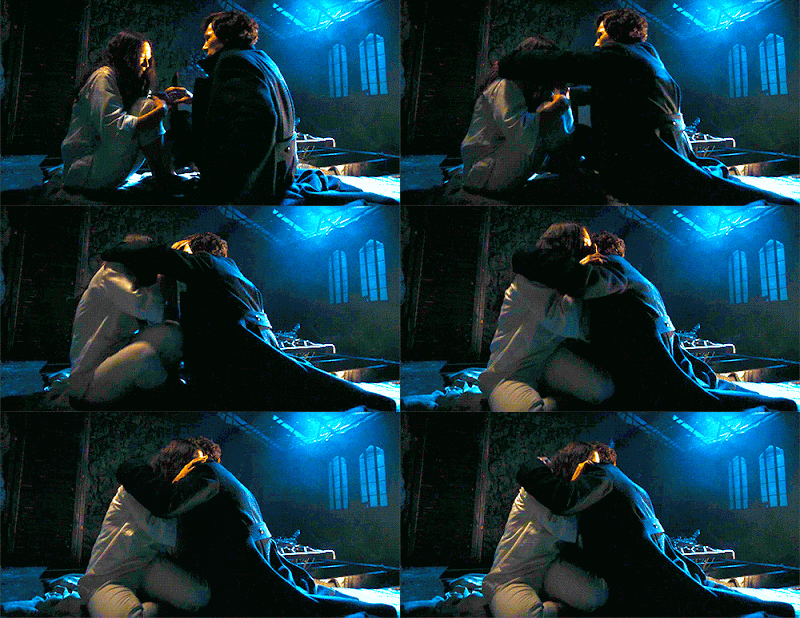

He learned to value his life because of what happened to Mary, he had admitted that he also succumbs to his impulses with Irene Adler (texting or beyond that, depends on what you want to believe), he fully realised that he would never ever want to hurt and make Molly feel like she’s being used by him because she’s his friend, he was able to extend a more human side of himself to John more than he did before, he finally understood and accepted Mycroft’s intentions and actions which I think mended their relationship significantly (this one hits me to the core so much), and lastly, he discovered that if he was left in the air in isolation, he might have ended up like Eurus, which is why he never wanted to make her feel alone again.

To me, it is groundbreaking because it left that cliche of someone running off into the sunset in the end and it’s all butterflies and rainbows. They wrapped it up with the characters still broken, but living through it day by day because someone chose to love, accept, and help them heal despite their flaws.

It is what it is, they keep on saying, because that’s how life is. It can be unbearable and it can most certainly be shit, but in the end, if we all let it, love – self-love, romantic love, familial love, platonic love – all kinds of love, will help us conquer all, within and beyond this show.

theleftpill:

Excellent analysis - and ironically it showcases my main frustration with the series and with Moffat and Gatiss: that it’s all crammed into just three episodes. The character arcs and narrative arcs, and these huge resonant themes, that they present in this series simply need way more time to get from A to X. John’s “cheating” shouldn’t come so abruptly out of the blue. Mary’s death feels rushed and “convenient”. Having Eurus’ entire existence seeded with only one line of dialogue in S3 doesn’t support the weight of her narrative. And I’m aware of “Redbeard” in The Sign of Three and His Last Vow - but those feel more like retroactive “oh lets make it about this instead” than actual foreshadowing. Eurus’ introduction, interaction, and denoument needs to happen throughout a whole series imo, to give it the attention it needs.

I like what you say about Mary’s death though - considerations of fridging aside, because come on we all knew it was coming, it really was necessary for *someone* to actually die, because as fantastical as this show is, at some point you need to ground it in reality. You need to have consequences, and the way these characters play with death, someone had to meet it. Mary is the obvious choice. And I also like what you say about the different “people” we all play in life. I like that Mary chose Mary Watson as the one to live and die as.

I wish we had gotten this played out over two series instead of one - S4 opens so many new avenues into these characters, and directions for them to follow, the themes are so deep and resonant I really wish they could have been explored instead of steamrolled.

vulgarweed:

Agreed about Mary, @theleftpill. While the fridging concept definitely applies because her death was fodder for John and Sherlock’s pain and personal growth, there are also ways in which it didn’t: it actually did come about because of her (past) choices and actions, and she also chose to throw herself in front of that bullet, so she did NOT lack agency. Some people are saying she would have been a stronger character if she had been written as an unredeemable villain. I profoundly 2000% disagree with that. We already have admirably loathsome villains on this show, we certainly did not need Mary to be one - In the close family circle of the show, I prefer morally grey characters, especially ones who start out dark grey and get lighter over time, but never turn to pure white entirely. Especially if they’re women, we don’t get to see enough redemption arcs for Chaotic Neutral women. And when it comes to ordering death, is she really worse than, say, Mycroft just because she’s more willing to look her prey in the eye than he is?

I went through a phase of hating her starting about halfway through His Last Vow, you know the moment. But I also always thought that Sherlock’s forgiveness was guarded but sincere, and he’s the one who gets to make that call, no one else. (Most murders can never be forgiven by definition, because the only person with the true moral authority to do so is dead. But if the victim has a Hollywood miracle and decides that he understands the reason and sympathizes and cares about the person who did it, it can happen.) And I always sincerely believed that Mary and Sherlock really liked each other, so once I got over the recoil, I started shipping Johnlockary pretty hard as a secondary pairing to Johnlock.

I think she did kind of need to die for the story arc, and while I miss her, I’m glad we got a whole episode that was mostly about her and the consequences of her past life. I liked the fact that the “Appointment in Samarra” story really resonated because Sherlock tried so hard to avoid fate - because at least at first he thought it was about him. It wasn’t. The destined meeting with Death that could not be avoided was Mary’s, and in true classic tragedy style, efforts to avoid the fated reckoning only wind up bringing it about by another route.

Also: Sympathizing with and forgiving Mary laid the groundwork for Sherlock being able to sympathize with and forgive Eurus.

I get why a lot of people don’t like forgiveness stories when truly horrible things are involved. But like it or not, that is the kind of story this is. And I do like forgiveness stories, because I’ve done bad things and I sympathize sometimes with those who need it. Forgiveness does NOT mean what the person did is OK. Far from it. It means moving on from that point. And in the cases of both Mary and Eurus, it means saying, “yes, you’ve done truly horrible things, but you are still a human being worthy of love. And I (Sherlock Holmes) am not only capable of love in general, I’m capable of loving you.”

S4 is 100% a story about love. Not romantic love, mostly, (which obviously disappointed a lot of people, but hey, I can easily name 30 fic writers who do romance/erotica better than Moftiss would). But family and friendship love, and agape. It’s a beautiful story, for all its horror-movie silliness (which I also kind of like, because campy horror movies are fun). The more I watch it, the more touching it gets.

You’re absolutely right about the rushing, though, @theleftpill. I feel like a lot of important character interactions got lost because of this. I wanted to know more about John’s feelings about the reveal of the real identity of his bus fling AND his therapist. (I wanted more of John’s thoughts and feelings about lots of things, I feel we kind of lost him as a character for a while there). Lestrade’s reactions. Molly’s reactions.

Sunday, 5 February 2017


A question about Molly and her 'bad day'
 (Sherlock meta by rosamund–maryhalf-past-chaffinch and vulgarweed)

rosamund–mary: 

So when Sherlock calls Molly and she says she had a bad day what defines a bad day as a mortician ? Would it be having to do an autopsy on a child? ??? I’m really curious and would love to hear your thoughts!!

half-past-chaffinch:

I love this question! Thank you so much for posting it!

To answer your question: maybe you’re right…having to do a difficult autopsy would be tough. Or maybe (harkening back to TAB) she had to deal with some hospital administrator or some doctor being dismissive with her for some reason. Or something else going on with work or with her family (we know her dad died, but don’t know much or anything else)

But Molly’s comment about her “bad day” it is almost a throwaway line, and it’s one that usually gets passed over as folks jump to analyzing the “meat” of the scene. So that’s why I’m glad you brought it up.

In the world of Sherlock, everything by definition revolves around Sherlock. That’s what we see, that’s what the show presents. But in that scene, with that line, the show lets us know that Molly exists, on her own, as a whole functioning human being even when Sherlock isn’t in the room. She has her own highs and lows, unrelated to the Great Detective. She was having a bad day before her phone rang, before Sherlock entered into it. She had something else going on in her life, and her emotional life, unrelated to him.

Sure, maybe some will say she was upset because she’d heard about the Baker St explosion, and hadn’t heard from Sherlock since then, so she was upset. But that didn’t seem to be it. If she was worried about him, wouldn’t she have answered the phone when she saw it was him? Or at least registered some visible relief that we could see even if she acted annoyed to Sherlock? But she didn’t; she ignored his call the first time he rang, and only picked up when he rang again. So it seems her “bad day” * was completely unrelated to Sherlock and his drama.

And I love that we got that little hint, that indication of the fact that the Molly we see with Sherlock is just the tip of the iceberg of who Molly is; there is a whole other part of her existence that we never see. But that is still there out of sight.

And I also love that when we see her, upset from her bad day, she is taking care of herself: she’s in her lovely kitchen, making herself a cup of tea (with lots of oranges apparently…don’t go near that woman when she is armed with a sharp knife :D ). She is not wallowing, she is not being self-destructive. She is upset, but she is doing something nice for herself.

*oh and Molly saying she’s having a “bad day” is just one of several dozen little callbacks Mofftiss gave us to S1 and particularly to A Study in Pink. It recalls her (I think) very first line in the who show, when she asks Sherlock “Bad day, is it?” when she finds him flogging a corpse in her morgue.

vulgarweed:

I just figured she had a bad day like any other person might have a bad day. She had a fight at work. She had a family problem. She had a conflict with a friend. She’s out of spoons and weary and had bad transit luck. She got bad financial news. She’s been a little bit ill and didn’t sleep well. Her rent got raised. Her cat is sick. Who knows? it’s not relevant to the plot directly - but she is a human being who exists in her own right 24 hours a day, she’s not just an auxiliary (or, god forbid, a fucking “mirror” for some other character, omg is that line of thinking hateful to me) so she has bad days.

Not everything DOES revolve around Sherlock. Nor should it. Pay attention to the women characters in their own right, and you will see evidence of their own independent lives. Mrs Hudson is probably the strongest example of this, but Molly definitely has her own existence and her own agenda.

Wednesday, 1 February 2017


The Final Problem: Making Sherlock Holmes a good man 
(Sherlock meta by fffinnagain, with reply by vulgarweed)

fffinnagain:

After The Lying Detective, I didn’t know what to expect for the last episode of series 4. John and Sherlock had reconciled on screen after hurting themselves and each other so deeply over the course of years. Mary had made her mark and worked herself out of the series. In two episodes, the main problems left by Series 3 had basically been resolved. What was left for the big finale?

With that trepidation in mind, I was honestly surprised by how much I enjoyed The Final Problem. It wasn’t easy to watch, but I found it powerful and convincing in ways that many others apparently did not. It tied up a lot of standing issues: the Moriarty business, from his initial interest in Sherlock to the last Miss Mes, the Why of Sherlock from series 1 onward, the Why of Mycroft and the broken Holmes Brothers’ relationship. It gave an emotional grounding to the fundamental contradiction of this Sherlock Holmes: a strongly empathic person trying to override sensitivity and compassion with extraordinary analytic ability that is (strangely) a source of great insecurity. As a closing chapter on the story of Sherlock’s progress from being a Great Man to a good one, I found it incredibly satisfying. The bizarre premise of a series of rooms on an island fortress was romantic and dramatic, but not out of style for a show that has featured delayed-action stabbings (TSOT), an un-convict-able super-villain (TRF), and a serial killer engaging in a battle of wits with every victim (ASIP).

Maybe I read too many fantasy stories about quests as a child, but I wasn’t bothered by the improbability of the plot, nor by the use of all non-protagonist characters to further this hero’s journey. This episode wasn’t about John, or Mycroft, or Molly, or even Eurus. However, their respective relationships with Sherlock have made him grow in different ways, and the sequence of crises forced on him by Eurus serve to prove how much he has changed, both to her and to himself. That the depiction of these tests put the audience (well, at least me) through the emotional wringer heightened (my) satisfaction and confidence in Sherlock’s transformation. In the moment, I didn’t care if the action did not make much sense; the why has always been more important than the how in BBC Sherlock.

Over the course of four series, Sherlock has gone from being a self-destructive solitary man-child to shouldering the responsibility of healing his own broken family, and that change in perspectives and priorities is huge. He is willing to learn from Eurus (rather than feel threatened by her abilities), to work for the sake of his parents and siblings (rather than push them away like a whiny teenager), and to care openly about his chosen family. Finally, Sherlock has the stability to treat strangers’ needs with respect and sympathy, as mature Holmes does the stories of ACD.

Besides capping the great progress of Sherlock Holmes, The Final Problem also moved me with the story of Eurus. There are plenty of stories about weirdly precocious children, but this was the first I’ve really appreciated about a younger sister, and it really hit home. Around the comic violence, Eurus is treated with sympathy, her struggle recognised and respected. This is helping me think very useful thoughts about my own familial relationships and that kind of impact is a hallmark of good art.

There was plenty more to enjoy in this episode (just as there was plenty to criticise) but a last point that mattered a lot to me was a big deviation from the usually crime-solving content of detective stories (or stories about detectives). Through the Holmes family’s history and present, we finally have a look at the consequences of violent crime and the criminal justice process on the families of the incarcerated. The temptation to forget, the importance of remembering, the intra- and inter-individual conflicts about engaging with loved ones who are or are deemed dangerous. The specifics were fanciful and not without their problems, but it’s an important change from having so many antagonists dismissed as unconditionally evil. T

he Holmes and Watson of ACD repeatedly weight the cost of arresting the guilty with consideration for their families, but on BBC Sherlock, the wrong doers tend to wind up dead or arrested without questions of fall out. We haven’t seen a real moral quandary on screen, and I hope that kind of story will pop up in some future independent story about our Baker Street Boys.

vulgarweed:

Beautiful. And yes, the description as “Love conquers all” was completely accurate. It did. It was about familial love. (Which, as Sherlock was quick and emphatic to state clearly, definitely includes John, and we can assume his daughter as well).

It’s not an easy love even for a more “normal” family, and Holmeses have rifts that can never fully heal smoothly. But I was moved to tears by Sherlock’s devotion to their violin duets - if it’s the only way to get through to her, the only connection they can safely have, it’s clearly important to him.

Could he so easily forgive her for killing his best friend so cruelly? Hard to say. What IS forgiveness exactly? Is it accepting what the other person did as OK? No, that’s not what it is.

This is, after all, a man who forgave his best friend’s wife for killing HIM (he didn’t stay dead long, of course, that does make a difference). Is that all just self-loathing, or does it indicate someone who’s learning to see sympathetic motives woven into the most unsympathetic acts?

I found a lot of things about Eurus stretched my suspension of disbelief even more than I’m used to on this show - but less so than on some other shows and movies I enjoy, so it wasn’t a dealbreaker.

I think it’s an episode that’s going to reward a lot of rewatches for me. I liked it better the second time than the first, and the third time more than the second.

Sunday, 22 January 2017


The hospital scene in TLD
 (A Sherlock meta conversation between 
consultingbeekeepersaddignisherlocktheconsultingdramaqueen, vulgarweed 

consultingbeekeepers:


Smith: I have a question for you. Why are you here?
Sherlock: You know why I’m here. 
Smith: I’d like to hear you say it. 
Sherlock: I want you to kill me.

addignisherlock:

this was one of the most heartbreaking scenes in this episode…..but then again this entire episode is heartbreaking

theconsultingdramaqueen:

Okay but can you imagine John and Lestrade listening to this recording???

addignisherlock:

I almost hope they do. Especially John. Because I think hearing this will really remind them that Sherlock is still just human like everyone else. They seem to easily dehumanize Sherlock and see him as just an addict, or a cock, or a liar, or whatever. That they sometimes forget that Sherlock is human with fears and feelings too. So yeah I hope if John does listen to it, that John would realize how human Sherlock is. And I hope John won’t dismiss it simply as “it’s Sherlock. He’s a good liar”

vulgarweed:

What I get when I watch this scene is that it’s a MAJOR turning point for Sherlock.

As long as we’ve known him, he’s always been reckless with his own life. He’s willingly put himself at fatal risk so many times - yes, sometimes for love but also sometimes just a solve the puzzle, as we see in the ASiP.

His revelation here, and the moment when he breaks, is when he sees his own death in intimate terms, slow moving and close up, cruel and ugly and enjoying his terror and pain, with no redeeming motive of sacrifice just joy in destruction, demanding his attention and not allowing him to deflect or dissociate or intellectualize.

Sherlock breaks because he finally realizes that he is not ready for his life to end. It’s not even about John or Mycroft or anyone else close to him. It’s him realizing that death is the END, and he is not ready to end. He’s been suicidal and flirted with death for so long that he ceased to take death seriously. Now that he must, he knows for sure that he DOES NOT want it.

Sherlock does not want to die. And now even Sherlock knows this. 

I hope that in TFP, we’ll see Sherlock eager and willing to fight for his own life. Because he knows now that he’s important to himself. (As well as yet another belated realization once again of the fact that he’s no help to his loved ones if he’s dead, but that’s secondary.)

astudyinsavage:

If you were dying, if you’d been murdered, in your very last few seconds, what would you say? Please, God, let me live.