Thursday, 12 January 2017


On Mycroft and trust
 (Sherlock Meta by thenorwoodbuilder)


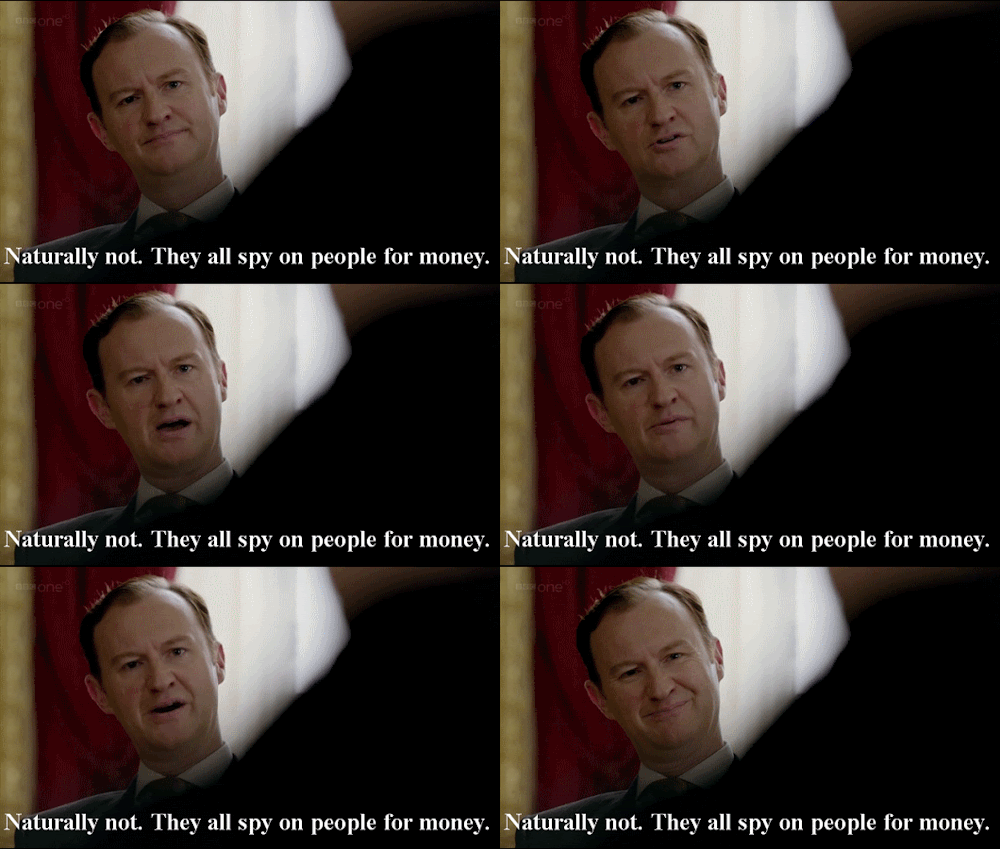
I’m always amazed at the amount of information about the characters that the writers (here Moffat) managed to convey through this very short exchange:

1. John establishes himself again as “Queen and Country”: he is initially very surprised that Mycroft doesn’t trust his own men, because he, instead, implicitly trusts his Country’s institutions: he once decided to serve his Country in the army, after all, so he supposes that one can trust one’s own Secret Service…

This is also one of the reasons why, according to me, once he realized that Mycroft was actually NOT a criminal mastermind, but instead (not only Sherlock’s elder brother, but also) a government official (or the British Government…), John coudn’t help but feeling that it was his duty to help him, both in relation to the cases he decides to submit to Sherlock (see tGG), and when it comes to keep Sherlock himself safe (albeit, in this respect, he was, of course, primarily driven by his affection and concern for Sherlock himself, as well as by his ability to relate to situations where one sibling has to deal with a “problematic” other sibling - two traits which, of course, both he and Mycroft share).

2. John is not the only one to have “trust issues”. Mycroft confirms himself (after his first appearance, in ASiP, upon which I’ll come back soon) as a person who doesn’t easily grant his trust to anybody, not even to people - his own colleagues and subordinates - who, afer all, have taken an oath to serve and protect their Country.

On one hand, it’s quite logical, in his line of work: for a man who (presumably) has made a career into the Secret Service, and who has a certain experience, is a sort of professional bias to always suspect of anything and anybody, just on principle. He presumably had occasions, in the past, to get first hand experience that this world is full of double- or even triple-agents, that almost nobody is what appears to be, and that almost everybody has his own secret agenda…

But, on the other hand, it’s also possible that Mycroft chose this particular line of work - in the Secret Service, amongst all the ways he could find to put his talent at the service of his Country and of its innocent citizens - also because of a certain personal attitude towards people: that is, it’s possible that he chose a work that requires, as a prerequisite, the attitude to suspect everyone, always, because he intimately was already persuaded that people - or at least the vast majority of people - can never be trusted. So, he entered the Secret Service (also) because it was a work that suited his persuasion that the majority of people would be capable of everything, under the right (rectius: wrong) circumstances, that nobody is totally trustworthy and loyal, and that always be on guard is however a necessity for any sensible person. A persuasion that, of course, his experences at work could only have strenghtened.

But then the interesting question becomes: WHY did Mycroft feel this way? WHAT in his past experiences - in his childhood or youth - persuaded him that nobody can be really trusted? WHICH betrayal had he to endure, from a person or persons he should have been able to trust unconditionally (and of course I’m thinking primarily to one or both of his parents…), and who, instead, revealed him/herself unworthy of such trust?

3. Obviously, this little exchange also offers the final proof that Mycroft’s initial “abduction” of John, in ASiP, with its corollary of threats and offer of a bribe, was just a way to “test” him, his courage, his honesty, and more generally his personality, in order to satisfy himself that Sherlock was not going to share his flat with someone who could be tempted to “sell” him away out of fear or greed - or, even worst, who since the beginning approached him with evil intentions (first of all, the intention to get leverage upon the British Government by hurting or kidnapping his one little brother…). A “procedure” that, given Sherlock’s quite placid - and even a little amused - reaction when John related his recent experience to him, was probably a sort of tried and tested routine, for similar occurrences. But a “procedure” the whole purpose of which John probably only realized after this little exchange at the Palace, given the small, understanding smile with which he replied to Mycroft’s observation about the “venality” of professional spies… (albeit I’m persuaded that John started to suspect Mycroft’s true motives since he discovered his identity, that is, that he is Sherlock’s brother; but he got a confirmation from the man himself only at this moment).

Even more, in this little dialogue Mycroft is basically telling John that he trusts him much more than he trusts his own men - not only when it comes to his loyalty to Sherlock, but also when it comes to dealing with delicate matters of State… And I suppose that, if already before this John’s attitude towards Mycroft was certainly not an hostile one, after this display of trust on Mycroft’s part, he couldn’t but reciprocate, as it is an instinctive reaction for human beings to trust in turn a person who demonstrates to trust us.

Hence, probably, the escalation of cooperation with Mycroft we see through this episode, with John and Mycroft discussing how to deal with a foreseable “danger night”, first; then John willingly reporting to (the person he believed to be) Mycroft (but was instead Irene) about Sherlock’s reactions to Irene’s death; and finally John and Mycroft discussing together whether tell Sherlock about Irene’s “second” death, in order to spare him more suffering.

Hence, also, the fact that Mycroft, during his second confrontation with John in tRF, feels the need to apologize apparently to Sherlock, but in fact, according to me, actually (and mainly) to John himself…

4. Finally, the other thing that gets a confirmation in this scene (albeit, in this case, we already could infer it by tGG) is that, when it comes to really delicate matters, the only person Mycroft feels he really CAN trust, his Sherlock. That is: he may not always trust his maturity and ability of stay out of danger’s way, but  he has not the slightes doubt that Sherlock could never, ever intentionally betray him, or his Country. Mycroft knows that his little brother may be stubborn, may be reckless, may be - as he’ll have to aknowledge on the “Bond Air” - a “lonely, naive man desperate to show off”, and therefore make foolish mistakes; but Sherlock would never deliberately hurt or harm his elder brother, would never intentionally fail him. Mycroft knows this, and is openly (or at least, as much openly as being an Holmes would allow…) aknowledging it in this scene.

With regard to Sherlock reciprocating this sentiment, and to my theory about the Brothers’ secret conspiracy in tRF, I’ll just point you to my previous posts.


Irene Adler is Not a Loser - Part 1
 (Sherlock Meta by wellingtongoose)

I really love Irene Adler in BBC Sherlock, but even more I love the complex plot of A Scandal In Belgravia. This meta is dedicated to discussing the intrigues and deceptions that are only hinted at on screen and play out behind the scenes. I aim to show everyone why Irene is not a loser but an incredibly intelligent and ambitious woman. On the way I explore:

* Why dominatrix is not her only line of business
* Why Irene actually phoned Jim Moriarty – and what deal they came too
* Why Sherlock was just a pawn in a much bigger game

A Disclaimer before we start… 

This piece isn’t about sexism or the portrayal of women in the media. It’s much more focused on the plot of ASiB and analysis of Irene’s motives as if she was a real person, not an artificial construct presenting a particular literary troupe. Certainly, there are things that I would have changed about Irene if I had been one of the writers but then there are many things I want to change about myself and can’t. In this case I am going to think of Irene as person – not a representation of the female gender – and just accept that she has flaws but they do not make her any less brilliant.

A Journey of a Thousand Miles…

vlcsnap-2013-01-09-19h53m32s255

We can assume that before she made this phone call she had already obtained sensitive material on her phone. I had always assumed the sensitive information she had was the MOD email but there is no evidence at that time, Irene realised its importance or that she even possessed it. We do not know the timeframe over which she was being pursued by the Americans – it might have started just recently before Sherlock and John turned up (remember there is quite a long period of time between the pool scene and Sherlock meeting Irene).

At the time of the pool scene the MOD email could not have been the bait that Irene used to hook Moriarty because even if she had it she didn’t know why the email was important even or that it was important. The MOD man might just have been talking nonsense in an attempt to impress her and the code itself was a load of jumble even to a cryptographer. Moriarty certainly couldn’t figure out the information either because Irene had to manipulate Sherlock into given them both the answer when they realise it was important much later on.

So Irene couldn’t have got Jim Moriarty’s attention by saying “I have a nonsensical fragment of an MOD email that, according to the stupidly pathetic man who’s in love with me, is going to save the world.”

She must have had much more than just that email on her phone. As she suggests to Mycroft – she has all sorts of things on there and I certainly believe that she does.

The Americans were after her for one single email but it doesn’t mean that Mycroft and the British Government weren’t after her for much, much more.

The Economics of Being a Dominatrix 

vlcsnap-2013-01-09-19h57m38s177

From the clients she chooses to engage with (high ranking police officer, best cryptographer in the country, an official from the MOD), I think her line of business is more than just being a dominatrix. I think the most lucrative part of her business is actually the information she gets out of her clients. I’m sure the thrill of having power over powerful people was also very enjoyable but Irene is a very pragmatic, cunning person and she likes money. (I think people over look the fact that the entire point of her plot was to extort billions from the British Government)

If you think about it, all the clients she has picked are exactly the kind of people that actual spies want to get close to - people with access to classified and/or sensitive information. Irene has basically set up the ultimate honey trap and she makes Anna Chapman (professional Russian spy) look like a complete looser. ¨

Of course she’s not a professional spy –she doesn’t report what she finds back to some sinister foreign organisation. Irene is a freelance, independent stock broker in sensitive information and I think this definitely suites her personality.

However being a freelance information broker has its disadvantages

1. you don’t always have the right customers
2. you are dealing with some very dangerous, very ruthless people at both ends and there is no tag team of CIA agents to watch your back.

Customers for sensitive information do not appear like punters rolling up at the curb. Their reasons for wanting classified/sensitive information are definitely shady and as people they are probably even shadier. Her customers might work for a multitude of foreign intelligence services or be unofficial/commercial/terror organisations but these people are hard to find. This is why she needs Jim Moriarty. Not just to find these customers but also to make sure the deal is sealed without any of these people harming her. 

I think initially Irene did manage to build a small network of contacts to pass information onto. However like any shrewd businessman when there is more supply than demand, Irene wanted to expand her business. This is the second reason she comes to Moriarty – she must have hooked him with an immediately financially lucrative set of documents. Imagine what other classified documents the MOD man might have leaked to her before the Bond Air email? As Irene say she usually likes to visit her clients more than once.

Let us not forget that Moriarty is still a businessman despite being obsessed with Sherlock. He might have thrown £30 million away to get Sherlock to come out and play but it doesn’t mean he isn’t looking to recuperate that money elsewhere. What Irene proposes is simple: she’s provides the data, Moriarty is the middle man and gets his cut of the profit which can be substantial.

Irene also needs to find her own protection and that is where her celebrity clients and her camera phone come in. Firstly, celebrity clients get one some exposure/publicity within their circles – yes she is extremely controversial but she’s not anonymous anymore. You cannot just make her disappear overnight and not have people ask questions. Secondly, there is no reason to believe that all of her clients hate her guts, she doesn’t openly screw over everyone she meets – it’s not good for business. Some of her clients might actually think they are in love with her. Irene has the great power of making people “feel special”. She can make people love her and love is much more vicious motivator – perhaps enough for a motivator for them to protect her against enemies foreign and domestic?

When all else failed she had the material on her camera phone to fall back on. When clients became threatening or violent – she can always pull out that smart little device. However I doubt this happened very often because Irene is perfectly capable of keeping her clients sweet.

Before the Americans started turning up with their armed hit squads, I think Irene’s protection was perfectly adequate. She had Jim Moriarty for the information customers and her own resourcefulness for her clients. Irene is a small-timer compared to the huge network of spies and informers that nation states employ. MI6 might have been aware of her before she threatened the Royal family but just as likely, she managed to fly under the radar. She’s very intelligent and Irene would have known how important discretion is. As long as her clients never linked security leaks to their own blathering, there is no reason why anyone would suspect a lowly sex worker and even if they did – she had enough on her phone to ruin them.

It was only when she realised that there were trained killers out hunting her that she started to fear.

The Anatomy of a Royal Scandal 

vlcsnap-2013-01-09-20h00m25s46

 - -

Whether or not Irene actually demanded something from the Royal family, we don’t know. Mycroft claims she didn’t because Sherlock doesn’t do blackmail - he simply tells them to pay her off. Telling the Royal family that she has the photographs does sounds like a prelude to making some kind of request or demand in the future as well as a power play. I personally don’t subscribe to the idea that the Royal Family “have people whacked” – they are not that unrestricted or even that shady. They could easily provide her with enough money to get out of the country and change her identity but that’s not what Irene is aiming for. -

Irene is aiming to extort billions from the treasury before she leaves the country (and yes she was plotting this before she knew about Bond Air as explained in Part 2). -

Now that’s what I call ambition. -

However the Royal Family can provide a good second avenue of escape if her plot goes to pot but this is only one of the reasons she informed them about the pictures. -

There is no evidence at the beginning of ASiB that Mycroft sees Irene (and Moriarty) as anything more than mere insects – little conveniences compared to the broad power plays of entire nations. However both Irene and Moriarty desperately want his attention for very different reasons.

For Irene Mycroft is literally the key to the treasury. Her plot was never about Sherlock at all, he was at best a vital pawn and amusing distraction. Mycroft is probably the only man who has the power to authorise the transfer of such vast sums she’s demanding in one night. He has control over the spineless brainless government ministers and he can pull their strings like a master puppeteer. First she needs to get him to the negotiation table and there is no evidence that Mycroft took her at all seriously. He certainly doesn’t take her threat to national security seriously given he has real, highly trained operatives who could retrieve that cameraphone but he doesn’t use them. Instead he opts for his little brother, a civilian detective.

Moriarty obviously wants information on Sherlock but he’s perfectly willing to play along with Irene when they have the same goal in common.

When the Americans started chasing her – Irene must have realised she stumbled onto something really big this time – something utterly out of her league. It might have taken some time but she did eventually realise it was the MOD email. I think the first thing she did was use her own contacts and resources to try and crack it but when that failed she showed it to Moriarty. 

Obviously Moriarty couldn’t make heads or tails of it either but he suggests a solution that will kill two birds with one stone - getting Mycroft’s attention and cracking the code: GET SHERLOCK. The best way to get Sherlock was through his brother Mycroft who just happens to be very old acquaintance of the Queen.

Sherlock doesn’t get Irene’s camera phone and Irene learns to be careful what she wishes for because she really has attracted the attention of Mycroft Holmes with this shenanigan. I mean how forgiving is he going to be to someone who drugged his little brother? Now it’s personal.

From this point forwards the pair of them: Irene and Mycroft are locked in a ruthless game of chess Continued in Part 2

Other Parts in the Series: Hidden Heroines of Sherlock - Molly and Sally Why Molly and Sally are not just one dimensional characters but prime examples from strong, independent, professional women

For a List of Other Metas regarding Irene, Mycroft, Jim etc: Heroes and Villains series.


Why had Mycroft never met other children before Sherlock did? 
 (Sherlock Meta by ibelieveinmycroft)

Anonymous: Mycroft is supposedly about 7-8 years older than Sherlock. How come he never met other children before Sherlock grew up old enough to meet other children? Surely Mycroft had had experienced "other children"before Sherlock was born? Their parents seem "normal" so they would've introduced their first son to other kids as toddler, surely? Because if both never seen other kids for sometime-even thought "Sherlock is idiot"- then they did have unusual upbringing after all...

Answer: It would be, indeed, very unusual!

Assuming that the house that we saw in His Last Vow was where the boys grew up, their home was was quite rural and remote. This shot, when Sherlock and John leave after drugging everyone, shows what is immediately outside the front doors of the Holmes household:

image

There is nothing but green fields for miles around. There may be the odd house dotted in the distance, but otherwise that is idyllic, secluded countryside.

It is equally likely that the canonical Holmes grew up in such isolation too, as it does lend a certain slant to this famous line from The Copper Beeches:

"It is my belief, Watson, founded upon my experience, that the lowest and vilest alleys in London do not present a more dreadful record of sin than does the smiling and beautiful countryside."

What little we know of Sherlock’s upbringing - a fondness for board games, pirates and a dog called Redbeard, alongside becoming obsessed with the Carl Powers story in the newspaper - seems to indicate that he was, in many ways, both a very normal and a very odd child all at once. This may be due to his parents attempting to normalise him and give him something more akin to a childhood, after Mycroft.

Seven years older, Mycroft was probably born just after his mother ended her academic career. A mathematician who, although a bit scatty, had a brilliant mind, likely chose to home-school her first born son - a step that would have kept Mycroft alone in that remote country house, nurturing an impossibly brilliant mind with mathematical equations and any book he could lay his hands on. This way, he could easily reach age seven without meeting another soul save for his parents.

Mrs Holmes probably home schooled Sherlock too - Mark Gatiss has said he thinks the Holmes brothers were brought up "like hothouse flowers" - and, after some years, she realised that he was gifted in similar ways to Mycroft. She will have wanted her younger boy to be better adjusted than her elder - so was probably the one to encourage him towards pirates and Operation and bought him the dog. But Mycroft will have held real sway over his younger brother’s forming intellect too, with Sherlock constant attempts to keep up with and surpass Mycroft’s unmatchable genius the foundation for more than a little sibling rivalry.

At some point, when Sherlock was old enough to remember, Mrs Holmes had taken the decision that both her sons needed to meet other children, likely realising, from the strange behaviour of her eldest son with his unwieldy genius that even her enormously intelligent second son could not parallel, that it was a mistake to have kept them so isolated and they should make some friends.

It went badly, of course. The realisation that the rest of the world were mostly unbearably ordinary cannot have been an easy revelation for the brothers, and especially not for Mycroft, who was much older and had been long working on the assumption that his incredible intellect was the norm.

I think this meeting, though, probably gave him a new found appreciation for his little brother, who could almost keep up with Mycroft and, compared to ordinary people was blindingly brilliant. It was this realisation that made Sherlock the single most important person to Mycroft in the world, and his only pressure point.

Wednesday, 11 January 2017


Sherlock wanted Anderson as assistant
 (Sherlock Meta by Ivy Blossom)

There are lots of things that occur to me far later than they should. The thing about Mrs Hudson that I should have noticed but didn't was the first one: I'm sure there will be a million more, because I am not particularly detail-oriented, to be honest. This is the second thing I just realized: Sherlock didn't originally want John to be his assistant. He wanted Anderson to play that role.

Sherlock: Who's on forensics?
Lestrade: Anderson.
Sherlock: Anderson won't work with me.

Not Anderson is an idiot, but Anderson won't work with me. Sherlock then proceeds to take John along with him to a crime scene, and is remarkably patient and accommodating with him. Why does he do that? Sherlock is neither patient nor accommodating as a general rule. When John deduces only the most obvious and basic details about Jennifer Wilson's death, Sherlock isn't scornful at all. Why does he behave this way?

Lestrade: He's not your assistant.
Sherlock: I need an assistant!

We know he doesn't bring John along for his own innate skills, because when John asks why he's there, as they're standing over Jennifer Wilson's body, Sherlock says, "Proving a point". He doesn't really care what John has to offer to the investigation of the crime scene, that's why he's not bothered by John's simple description of the cause of death. That wasn't the point.

He's trying to make Anderson jealous.

These two appear to have a tumultuous relationship; they must have argued over bodies before. Sherlock must respect Anderson's abilities; why else would he want him as an assistant? So Sherlock wants to demonstrate, in the most childish way possible, that if Anderson won't play ball, he will lock him out altogether. That's the worst thing Sherlock can imagine: being tantalizingly close to the crime scene and his own dazzling deductions, but not be able to hear them or participate.

So Sherlock slams the door in Anderson's face. It's not because noting that Rache is a German word is dumb (It was something that passed through Sherlock's mind as well, as we know); it's because Sherlock is proving his point.

I don't need you. See? See me not needing you? How do you like that, Anderson? HOW DO YOU LIKE THAT? I can deduce the fact that you're cheating on your wife with Sally, I know what you were doing last night. See? Aren't I good? That's how good I am. You want to be my assistant, Anderson, don't you. You need to, because I'm dazzling and you need to watch me. If you ask really nicely I might let you act as my assistant next time. I just might. 

Sherlock doesn't realize at that point that the perfect assistant for him is John. Anderson won't fire a bullet with the steadiest of hands through a window for him. Anderson won't help him behave appropriately in social situations and smooth out the rough edges of his interactions. Anderson may admire Sherlock's abilities, but he'd never say so out loud. Anderson will never love him. John's arrival utterly alters the job description of "assistant" for Sherlock. We never hear the word "assistant" again, in fact (to my knowledge).

Sherlock's reactions toward Anderson, and all the negative things he has to say about him thereafter, appear, in this light, to be more a reaction to Anderson's rejection of Sherlock than any scornfulness about his abilities.

Sherlock has the emotional life of a nine year old.


Janine, reconsidered 
 (Sherlock Meta by mild-lunacy)

I was rewatching HLV in preparation for The Reckoning (aka Series 4), and I noticed something off about the Janine scene at Baker Street. As we know, Sherlock was acting weird, but then, he was *acting*. People have various explanations of how/why Janine was acting weird. Most people point to her willingness to forgo sex with Sherlock as the odd thing, or alternatively her willingness to believe he was really proposing. The usual point is, how could a savvy, smart woman go for that?

Well, that’s what I’d call an example of an ‘argument from real life’, which is almost always a dead end when analyzing genre fiction. I realize it’s really, really popular for a reason, and that is that it comes really naturally and is part of how most people process and relate to stories. That being said, I’m inclined to dismiss it. If you think these points suggest Janine isn’t believable or coherent as a character, fine. That simply means you’re not satisfied with the show, but that’s not offering a useful critique for further analysis. Nor is it a good reason to go against explicit canon and insist she did have oral sex with Sherlock at least. Anyway, the oddness in Janine that I’m speaking of is the stuff John canonically found weird himself, based on his scandalized, weirded out look: coming out without her bottoms, calling Mycroft ‘Mike’ and blatantly helping herself (staking a claim) in the kitchen. In other words, she was both forward and rude, in context: not acting very British. Then she was super-demonstrative, sitting in Sherlock’s lap later; people have theorized that this is because she knows about Sherlock’s plans, but there’s a simpler explanation. One that doesn’t require breaking a plot point in HLV (always important).

Janine’s inappropriate behavior fits if she was actually *trying* to make John uncomfortable, hoping to rub it in with her new relationship to Sherlock. Not to help Sherlock for whatever reason, but because *she* was jealous. Remember, she knows how important John is to Sherlock because of their conversation at the wedding. Sherlock made his fixation on John clear by his behavior there, and in fact Sherlock rejected her at the time (both sexually and as a candidate for the position John’s marriage represented an end to). The walking around half-dressed makes sense if you essentially want your lover’s ex to suffer. It really is that simple sometimes, and it also makes sense as a mirror with Mary’s dynamic with Sherlock and John in HLV, as well. Mary was starting to resent Sherlock’s role in John’s life as well, sniping at him earlier in the episode about some people not having heard of Sherlock.

The whole performance being directed at discomfiting John becomes truly obvious when she tells Sherlock right in front of John, “I’m the only one who really knows what you’re like, remember?”

That’s just *blatantly* a reference to John as well as John’s (presumably former) role in Sherlock’s life. It’s the sort of thing you don’t say in front of someone’s questionably-ex 'partner’ if you don’t have to, or you’re being friendly. If you’re not trying to score emotional points, you don’t say that sort of thing even to 'play along’ (assuming she’s doing that, rather than Sherlock, which I think is the actual reality of the situation). We know that Janine is canonically nasty and vengeful (from her going to the newspapers about her sex life with Sherlock), so this behavior is totally understandable. Further, if she was taunting John right then, it makes sense she’d been in that mode the entire time.

Not to say that this is somehow an anti-Janine post, but I’m guessing that one reason fandom hasn’t really talked about this before is that it’s not particularly flattering to Janine. We tend to be a bit protective about female characters in the show. In Series 3, however, every female character– Molly, Janine, Mary, even Mrs Hudson– repeatedly acted somewhat insensitively, and everyone except maybe Mrs Hudson was also manipulative and even emotionally abusive to various degrees. With Molly, I’m referring to the contentious yelling episode at the lab, and with Mrs Hudson, I’m mainly referring to the multiple times in TSoT where she mysteriously stomped over Sherlock’s apparent anxiety about John’s impending nuptials. Mary, on the other hand, exemplified every single aspect of this sort of insensitive, manipulative behavior throughout the Series, of course.

The other reason I haven’t seen anyone mention this interpretation before in the Johnlocker circles I travel in is probably because it treats Janine’s canonical heterosexual/heteroromantic feelings seriously. There’s not much I can say about that except that it’s my best judgment that they were indeed real.


ASiP Retrospective: They Won’t Work With Me (Because Only John Will)
 (Sherlock Meta by radvera, just-sort-of-happened and ivyblossom )

radvera: 

That’s right, it’s 2016 and I’m writing a Johnlock meta about A Study in Pink. Luckily, it doesn’t matter that I was an infant when this episode first aired because Johnlock is the one facet of all our lives that is eternal and will always be. I’m also revisiting season one again because I love dying.

Not that we haven’t noticed and written extensive metas about everything in the show, but did you ever notice or write an extensive meta about how Sherlock says, “[They] won’t work with me?” The first time he says it, he’s talking specifically about Anderson, saying he needed an assistant but that Anderson, for some reason, wouldn’t work.

SH- Who's on forensics?
GL- It's Anderson
SH- Anderson won't work with me

Later on in the episode, it becomes very clear why Anderson wouldn’t want to work with Sherlock. But what about that second time he says it? Sherlock is asking John if he’d take a look at the body; Lestrade protests, saying they had a whole team of medical people outside, and Sherlock replies, “They won’t work with me.”

So what, exactly, does that mean? Anderson, understandably, is not willing to work with Sherlock on cases, but did Sherlock really offend the living hell out of an entire team of medical experts to the point where they can’t bear to put aside their personal distaste for the sake of professionalism and work with Sherlock on a case? Actually….possibly. But let’s take a look at that first “Anderson won’t work with me.”

GL- Well, he won't be your assistant
SH- I Need an assistant.

Why did Sherlock insist that he needed an assistant? That’s like, not even true. Sherlock doesn’t NEED an assistant, he just would LIKE one. He works better with one – speaking aloud to someone else helps him think – but Sherlock saying he needs an assistant and then ultimately agreeing to come to the crime scene even though Lestrade didn’t promise him an assistant at all sounds like he was just trying to kick up drama when there was no question whether or not he would go in the first place. But was he just being a baby, or was he trying to get out a message to a certain someone sitting 10 feet away? In this context, listening to this conversation, the audience is clearly meant to think immediately of John when Sherlock says that he needs an assistant. The real question is, did Sherlock intend for John to be his assistant from the minute Lestrade walked through the door?

After twirling around for a while, Sherlock puts on his coat and his little scarf and bounds out the door, leaving John and Mrs. Hudson in the dust. Mrs. Hudson then briefly talks about her husband to a pissed-off-looking John, and John yells because what else does John even do besides yell. Mrs. Hudson is off to make tea and John opens up a newspaper. We’ve all seen it like a hundred times so I’m paraphrasing.

But then…Sherlock comes back. He appears at the door again, purring about how John is an army doctor. Did you guys ever notice how long of a while it is between the moment Sherlock leaves and the moment he comes back? True, it seems like a very short time – only a few things happened and only a few words were said. But it’s kind of a long time for Sherlock to be gone, especially the way he was swooshing around, and we know how fast Sherlock can swoop down a flight of stairs when he has someplace to be, only to decide to…come back? And, unless I am completely misinterpreting the layout, there are only two flights of stairs between the ground floor and Sherlock and John’s flat, because the flat is just one floor up, right? So…when did he decide to come back? When he heard “Damn my leg” and decided that he couldn’t miss out on John’s super hot yelling? It’s possible, but it’s also possible that Sherlock had intended to come back into the room anyway. What I’m saying is, Sherlock must have deduced somewhere between meeting John and the moment when he asks him to join him to the crime scene that John would actually WANT to go. That he missed the adventure and would WANT to be his assistant. And, after all, Anderson won’t work.

GL- We have a whole team right outside
SH- They won't work with me.
GL- I'm breaking every rule letting you in here...

Fast forward to the second time Sherlock says “They won’t work with me.” An entire professional medical team refusing to even be in the same room as Sherlock, or just Sherlock bullshitting so Lestrade will let his bf take a look at the evidence? I think it’s the latter. I think Sherlock is not only curious about how good of a doctor John really is, but he wants to see if they’re actually compatible. (Not that being a hot army doctor doesn’t immediately put you on Sherlock’s Acceptable People List.) And maybe Sherlock isn’t necessarily comfortable with or ready for a relationship at this exact moment, or maybe he is, but at the root of it all, having John as just a friend is a really, really good start.

And maybe it’s not just Sherlock talking, either, when he says “They won’t work with me.” Maybe it’s the writers trying to tell us something. If something is repeated, pay attention to it, right? This show has constantly, since the very beginning, repeated lines, made the same thing pop up multiple times as if to say, “Hey, this is important so why not pay some attention to it, because we are trying to tell you something here.” (@ the entirety of The Abominable Bride) When Sherlock says “They won’t work with me”, maybe it’s the writers, the producers, the Sherlock team, Jesus, and all them, trying to say, “No one else will work.” Lestrade quickly and nobly offers his squadron of doctors and Sherlock shoots them all down at once. They won’t work with me. Because there is only one person in this entire show that really, truly, undeniably works with Sherlock.

They won’t work with Sherlock, because only John will.

just-sort-of-happened: 

I love this. Also, makes the TEH Works Beautifully sign a callback to this. A reminder of how well they fit together.

ivyblossom:

But John’s first outing with Sherlock isn’t a test of John’s skills at all, or even of his compatibility as an assistant. John doesn’t need to prove himself useful at that point, which is good, because he isn’t. Sherlock still wants Lestrade’s team to help him. The reason Sherlock brings John along to the crime scene was to prove a point to Anderson, to Sally, and to the rest of Lestrade’s team who refuse to work with him. What was that point?

You won’t help me? That’s fine. You’re expendable. I don’t need you. I’ve found someone else to take your place, look how easily I did that! Does that change your tune? Don’t you want to be inside the room rather than outside it? 

Sherlock is intensely petty and childish, and he brings John along to make Anderson jealous. He wants to shut Anderson out the way Anderson wants to shut Sherlock out. The fact that John is an army doctor is helpful in making his case for bringing him in to Lestrade, and make the whole thing seem at least marginally legit. But it’s not John he wants at that point. John is just his accommodating flatmate with an obvious lust for adventure. It’s Anderson and his team he wants in the room with him.

You can tell this is true because the most important part of John’s presence at that first crime scene was certainly not his contributions. He agreed that the victim was dead. John is resolutely not useful at the crime scene, but Sherlock isn’t petulantly disappointed about it. In fact he was gracious and patient with John’s stumbling deductions; how out of character! He doesn’t actually care what John says about the body. He doesn’t need John to have any deductions about it. He only wants John to take up time so that Anderson has to wait at the crime scene. He wants to slam the door in Anderson’s face and make him wonder what was going on behind it. So John has already fulfilled his role, as far as Sherlock’s concerned. Proving a point.

John goes on to completely surprise Sherlock several times: first by being as enthusiastic about deductions as Sherlock is. He wasn’t counting on praise. He wasn’t even looking for it, and he doesn’t know what to do with it. But it’s nice, and it changes things. Then, John goes on to demonstrate his ultimate capacity by figuring out where Sherlock is and shooting the cabbie with the steadiest of hands. Sherlock really wasn’t expecting that. 

What started as a petulant trick to get Lestrade’s team on side turned into discovering not only an assistant but a true partner. That’s the moment when John becomes, not just someone “who will work” with Sherlock, but someone who takes his russian roulette life and makes it about something much more. John makes him more than a puzzle solver. John makes him a hero.


The Love Story of Sherlock and John 

(Sherlock Meta by Ivy Blossom)

I’m a broken record on this: Sherlock is already a love story, and it’s been a love story since the beginning. Nothing that happens in the next two weeks or 10 years will alter that fact. Nothing whatsoever!

Sherlock and John have outsized feelings for each other, and they both know it. Everyone around them knows it. So far this story has been largely about the various ways they try to make sense of this basic truth, and try to find an arrangement that satisfies them based on what each of them thinks they want.

They try being friends who solve crimes together; John’s dating gets in the way, and he fails to distinguish between one girlfriend from the next. Without discussing it, they become monogamous and ambiguous life partners who sometimes share a bed and don’t bother correcting people who assume they’re lovers. Sherlock, with his big ego and low self-esteem, fails to understand the nature of his complicated relationship with John and inadvertently breaks up with him (oops). Two years later, Sherlock wants his relationship back, but John has understandably moved on.

But John can’t quit Sherlock altogether. He needs and loves Sherlock as much as Sherlock needs and loves him. But how do you square this circle? They are very different people who appear to want very different things. John wants a romantic, ideally sexual relationship and everything that Sherlock is. Sherlock wants John to solve crimes with him and be with him at all times, and artfully dodges everything else.

John shifts his language to best friend, best man, godfather of my child, and they slip back into something of their former closeness, but with the addition of Mary. Their relationship is still far more intense and involved than would be considered usual, but what’s the word for it? What are the rules?

John’s happiness is reliant on his relationship with Sherlock. Fortunately Mary doesn’t mind, and fortunately Sherlock is prepared to do whatever’s required of him. Mary and Sherlock learn to comfortably share John, though it’s not clear that John is comfortable being shared. You’d think he’d be happy, he’s got everything we thought he wanted: the normal life and romantic/sexual relationship with Mary that he seemed to crave, even a child, and he still has Sherlock. Everything should be perfect, but it isn’t.

John doesn’t just love danger and adventure. If he did, Mary’s danger and adventure would be equally thrilling to him. He doesn’t just love hints of sociopathy and acting as someone’s moral compass, or he’d be as invested in helping Mary become a better person as he is in helping Sherlock. Mary’s brilliance doesn’t excite him the way Sherlock’s does. John is a man with trust issues: he isn’t able to forgive Mary the way he’s able to forgive Sherlock. John’s feelings about Sherlock go beyond the adrenaline and the thrill of danger, and beyond a mere admiration for his abilities.

People don’t always understand what it is they want. Sometimes it’s through convolutions like this that they work it out.

Considering this progression, it makes perfect narrative sense for John to act upon the knowledge he’s gained about exactly how deeply and irrevocably in love with Sherlock he is, and that he is not capable of forming this unique kind of bond with anyone else. It makes sense that Sherlock, who has thus far has deliberately avoided romance, love, and sex, to finally mature enough emotionally to accept that he has these needs as well. It makes sense for them to admit all of this in one way or another. They are made for each other. They are both better people when they are together. They will only be truly happy with each other.

If Sherlock and/or John decide not to address this, it will be a tragedy in the classic sense. But it will not mean theirs has not been a love story.

Tuesday, 10 January 2017


Love Live Irene Adler 

(Sherlock Meta by Ivy Blossom)

I love it when Irene comes up, because Irene is the embodiment of Sherlock’s sexuality. She’s the question that he tries very hard to ignore. She is the road not taken, but a road he could still take, possibly, if he wanted to. When Irene pops up, it’s a cue to think about Sherlock as a sexual being. It’s that for John as well, clearly.

I don’t want to be self-referential about this, but I feel compelled to be tonight: we fanfiction writers know how great it is to have Irene crop up as a conversation between Sherlock and John. It’s a crisis point conversation. It’s the best way for John to ask all the questions he wants to without actually asking them, and that’s pretty much what happened here as well. He wants to know: are you straight, are you gay, what are you, Sherlock? What do you want? Do you love her? Is it her, or is it me? 

That conversation usually ends like this: “I could go to her, but I’d rather stay with you.” (Why would he do that, John? Ohhh right, because he loves you!) We’ve all done that, haven’t we? Haven’t we all written that in one way or another? I don’t want to disparage my favourite screenwriter by saying “low hanging fruit,” but…Irene is low hanging fruit, we all grabbed it, didn’t we?

I like this idea that Sherlock sometimes responds to Irene’s texts. That’s good; that’s some ice melting off of him. To me that says he’s been thinking about the possibility that maybe a sexual relationship is something he wants. With her? Probably not. But she’s an entry point to it, she’s his libido, and yes, he has one, and he just acknowledged that. That’s great. Tonight, in this episode, Sherlock acknowledged that he sometimes considers the possibility of engaging in a sexual relationship. That’s huge.

I’m so glad Irene came back up just now.

John was about to leave. He was going to abandon Sherlock 20 minutes early, why? He’s trying to put distance between himself and Sherlock because he is not the man Mary thinks he is. Does this make sense? What does that have to do with Sherlock?

And why does he suddenly need to tell Sherlock what to do about Irene?

Because it’s not only Mary who needs him to be a good man. Sherlock needs him too, and John feels that he’s failed both of them. Why is he sending Sherlock off to Irene? He’s saying: I’m not good enough for you, Sherlock. Irene loves you too, go to here instead.

But that’s ridiculous. We all know Irene can’t keep Sherlock right. If anything, she’d send him down the worst paths, as she’s done before. John says to Mary, and to Sherlock: I can’t be the man you need to be. I cannot live up to your expectations. I am not that man.

And both of them say, yes you are. You’re human, you do the best you can, and that’s why we love you, and it’s good enough for me.

And John hears that, and he doesn’t leave.

I like it.


Evaluation of John's reaction to Sherlock in The Lying Detective

 (Sherlock meta by Ivy Blossom)

We knew from the outset that this series was going to be about demons. What’s interesting, and unexpected, is that so far it’s been about John’s demons, not Sherlock’s. We didn’t really think about John having demons, but I think that was the point.

Everyone in this story has a high-octane dysfunction of some kind. What’s always been true is that Sherlock is seen as the sexy, amoral weirdo who is secretly normal on the inside. John is the opposite. He’s a milquetoast, average guy on the outside, and an violent, rampaging action hero on the inside. Both Sherlock and John aspire to be what they project themselves as, and do their best to fight, dismiss, and hide from their inner reality. That core conflict is the fuel that drives each of them to despair.

Resolving this inner/outer conflict is the overarching theme of Sherlock. We see this very clearly with Sherlock himself: this is the story of how Sherlock learns to accept his human needs and emotions and becomes a greater consulting detective because of it. But running in parallel, we’ve now discovered, is the story of how John reconciles his inner monster with his stout, ethical heart.

We always thought it was Sherlock who was striving, and often failing, to meet John’s high expectations. But it turns out that the opposite is also true: Sherlock’s (and Mary’s) idea of who John is forces him to be that man, too. John knows he fails, but he doesn’t think Mary and Sherlock know this, and surely they would reject him if they knew. They can’t know how he struggles to be who they think he is. This series shows us exactly how.

We think of John as being moral, patient, forgiving, and above all, profoundly fair. But he holds Sherlock responsible for Mary’s death when it was clearly not his fault. John is meant to be the good guy, but he cheats on his wife and lets his grief and his anger overtake him when he beats Sherlock bloody. These things are so inconsistent, and no one can tell you that better than John Watson himself. He hates this about himself. These are his demons. He cannot live up to the expectations he has set for himself, let alone those or the people he loves. He fails them, badly and repeatedly.

That’s why John tells Sherlock to go to Irene. Because he knows what Sherlock needs him to be, and he knows he cannot deliver. He is a fraud.

Sherlock knows all about being a fraud. He is not a sociopath; he’s a profoundly emotional man who wants to love and be loved. Of course we know that by now. We know that the best Sherlock is a blend of all that he is, not just one or the other. The same is true for John. The guy who sprained someone’s wrist for not answering a question, the guy who shot and killed an unarmed cab driver because Sherlock was about to voluntarily swallow a pill that might be poison, the guy who beat Sherlock until he was spitting blood, that guy, with his desire to be loving, normal, good, that guy has the capacity to be a hero.

Sherlock embraces John’s inner violence, he always has. It’s the thing that first drew Sherlock to John, his improbable contradictions. He accepts, and even depends upon, the monster in John.

Is this a template for a good, healthy relationship? Uh, no. Are you kidding? No, these people are not moral exemplars by any means. They are profoundly and dangerously flawed people. But they have the capacity to be good, to be great, even, with each other’s help.

Sunday, 1 January 2017


Why does Sherlock show Molly affection?
 (Sherlock meta by fuckyeahsherlolly)

Q: Why does [Sherlock] show Molly affection in that way [in TEH]? Why did he care that he hurt her on Christmas [in ASiB] ? He's upset people in the past and not thought about it twice. John's teacher girlfriend, Hudders and the flour, Lestrade... Always. Why apologize at all, and furthermore, why was he actually upset (enough) that he'd hurt her? I understand the day they spent [in TEH] was a thank you. He was kind, cordial, accepted her help. That's a lot from him. So why say all of the things he said? Why chips? Why kiss? [...]

A: For me it has a lot to do with the fact that he truly and utterly cocked up. Sherlock wasn’t being ‘cruel’, he was 'teasing’, but he didn’t understand the weight of his words until he saw what everyone else already knew, that the gift was for him, that she cares for him. He doesn’t understand that, in the same way that he didn’t understand that John saw him as his best friend - he’s at a loss, because he doesn’t see himself as a person who is worthy.

I think a lot of what he does try do to in series 3 is to show that he’s much more receptive, not afraid, but it’s more the - “you can’t do this anymore” that gets me really. It’s not supposed to mean anything, is it?

Then why say it, why not go for chips?

The kiss is almost like a goodbye, like this was their first and last time doing anything like this, because she is engaged.

And then there’s the fact that she slaps him in the later episode, and tension is high, and I’m basically on the edge of my seat wondering what the hell is going to happen between the pair of them in series four.

Whatever it is, I’m ready (not really).


One Last Little Pre-S4 Molly Meta 
 (Sherlock meta by theleftpill)

[...] So I was thinking this morning about TAB, and how it’s all about *women*, both their importance in the world and Sherlock’s (raging hard-on) High Regard and Esteem for them, and thinking about the various metas written about why Sherlock initially sees Molly as a man. A lot has been said about her needing to be in disguise to hold her position in the Victorian era, about whether Sherlock knew or didn’t know that she was a woman, but one idea I haven’t seen:

Molly’s reveal in the church reveals her to Sherlock (and to the aware audience) that she’s a woman. This happens in Sherlock’s Mind Palace. They share a tender moment of recognition. This is the moment when Molly changes for Victorian Sherlock from a trusted and equal colleague, a professional in a professional capacity, to a real human being, to a woman, to a personal connection.

This is the moment in Sherlock’s brain when Molly shifts. Ever so slightly, if you weren’t paying attention you would miss it, but Molly changes for Sherlock here. She’s no longer just the pathologist, she’s no longer a trusted and dear friend. She’s now a woman.

Series 4 has answers. Let’s see where it goes.

Monday, 11 April 2016


Why does Mary not recognize Sherlock?
 (Sherlock Meta by Ivy Blossom)

It seems odd to me that Mary does not recognize Sherlock when he shows up at the restaurant in The Empty Hearse. 

If she is secretly employed by Moriarty, or is Moriarty, or is in any way related to Moriarty and his various and nefarious enterprises, either as an assassin, a colleague, a family member, or whatever, surely she would recognize Sherlock right off. If her purpose in lying to John and staying close to him is in any way related to Moriarty’s plans for Sherlock, she definitely should have.

If she is none of these things, and is merely a secret contract assassin with no ties nor interest in Sherlock Holmes whatsoever, it’s still odd hat she didn’t recognize him, given a) Sherlock’s notoriety, combined with b) her boyfriend’s past and his current status as Sherlock’s mourning best friend. She’s surely seen pictures of him. How did she not recognize him?

If she did recognize him for either of these very reasonable reasons, but chose to pretend she did not recognize him when John did in the restaurant in The Empty Hearse, what purpose could it possibly serve?


Why on earth did Sherlock investigate Mary's guests and Mary's ex-boyfriend but not Mary herself? 
(Sherlock Meta by beejohnlocked and ivyblossom)

Anonymous asked: 

Why on earth did Sherlock investigate Mary's guests (I assume Archie was one of hers since John never acknowledged him) and Mary's ex-boyfriend but not Mary herself? He found out about her stolen identity and that she'd been on the run for five years pretty quickly after getting shot, so it must not have been that hard to find information on her. He plans every detail of the wedding and studies David's Twitter habits but doesn't once think of at least googling her like he did Sholto?

beejohnlocked:

Oh nonny, there are so many possible answers to this question. I’ll take a stab at it and give my personal reading of the situation.

I think Sherlock had a huge blind spot when it came to Mary for no other reason than she was John’s chosen person. Sherlock came back from a two year absence in John’s life, after killing himself in front of John, and Mary had already been in the picture for several months. To say Sherlock feels immense guilt over what he did I think is an understatement. You see it in the way that he goes above and beyond as John’s best man and in the way he treats everyone around him more kindly. When he left, he hurt John badly. It doesn’t matter if John forgives him or not because he isn’t over it and Sherlock knows this. In some ways, it’s a simple case of “shoot-the-messenger” syndrome. Look at what happens in TGG when Sherlock to deuces that Moriarty is gay. Molly blames SHERLOCK for spoiling everything. And keep in mind, Molly wasn’t even serious about Jim. Now let’s look at the situation in TEH. John is engaged to marry this woman. If Sherlock brings up the misgivings he has about her, it’s possible, (even likely given John’s state of mind at the time), that John will get angry at him about it, especially given Sherlock’s track record of rudely picking up on the personal business/flaws of others.

That being said, this idea that Sherlock was “slow” as Mary puts it, I don’t believe for a minute. Sherlock knew there was something off about Mary. But he didn’t know what it was, and John chose her to be with, and I think Sherlock decided to give her the benefit of whatever doubt he had for John’s sake. We saw Sherlock notice about the skip code, and we saw him notice about Mary knowing Sholto’s room. He knows that a lot of people don’t like her. He deduced that she is a liar. So this idea that Sherlock doesn’t realize that there’s something off about Mary is incorrect as far as I’m concerned. For example, if you look at something like the David situation, to me it shows that Sherlock doesn’t trust Mary either. If Mary had an ex-boyfriend hung up on her but had no interest in anything happening between them I think Sherlock could trust her to take care of herself where David is concerned. He certainly would not feel the need to downgrade David’s relationship with Mary and make it so that he can only see Mary when John is there to supervise. If Sherlock trusted Mary, he wouldn’t have to worry about what would happen with David and Mary alone, would he? But it is a concern for him, which means that Sherlock doesn’t completely trust her.

Sherlock is focusing on the things that he can control. He can’t control John and the fact that he’s chosen to marry this woman. But he CAN control David and get him to back the hell off.

As for why Sherlock didn’t investigate Mary, he knows that there is likely something to find, something less than good. Given that Sherlock just spent two years keeping something huge from John and feeling guilty about it, if he knew for sure that there was something bad about Mary he knows he would have to tell John. I think Sherlock is just hoping that whatever is in Mary’s past isn’t too bad and just leaving it as it is and choosing to believe that she loves John and will do right by him. Blissful ignorance as it were. Thanks!

If anyone has anything to add, or if you disagree, feel free to respond!!

ivyblossom:

Interesting. I think Mary was right; Sherlock was “slow” to figure her out.

Sherlock didn’t think there was anything off about Mary, as far as we can tell. He thinks he can see what she is, and he accepts the evidence of his senses. We see his deductions about her; they were overwhelmingly normal and upfront. The secret tattoo, her political leanings, the fact that she bakes. Public things, private things, all right there and obvious to Sherlock. Everything he sees is reasonable, rational, logical, and normal, making her seem to be exactly what she says she is.

He knows that she’s a liar. But what’s that mean? Everybody lies. Is that something to suggest that her whole identity is false? Everything Sherlock can see about her is 100% harmless and normal, even her secrets. Even the fact that she lies. John lies, too. What he doesn’t know is that the deductions he’s making about Mary are themselves based on lies.

Mary make herself appear to be exactly what she wants people to think she is, not only in what she says, but in the expression on her face, what she wears, how she holds herself, and what she chooses to say. She is a master actor, perfectly method. She is very good at taking on a new identity and making it so close to real that it nearly becomes so. She was good enough to fool Sherlock, and Sherlock was fooled.

I’m sure Sherlock did investigate Mary. He found out what everyone in John’s family thinks of her. He knows about her ex-boyfriend, their interactions. You don’t get to the ex-boyfriend without stalking Mary. To complicate things further, he likes her. He doesn’t like a lot of people, but he likes Mary. And she likes him. She’s a friend. He thought they understood each other and cared about each other. Liking her helped him to ignore things he shouldn’t have.

It wasn’t belated research that revealed Mary to Sherlock. It was new evidence.

Sherlock doesn’t know how wrong he is about Mary until the moment that she shoots him. He steps forward when she tells him not to; the person he’s certain Mary is wouldn’t pull the trigger when a friend is offering to help her. But he’s wrong. That bullet is the evidence that he doesn’t know Mary at all.

Understanding that resets Sherlock’s sensor. He combs back over his interactions with her to see what he’s missed. It’s inner research, not a google search.

If the internet could uncover Mary’s secrets, killing Magnussen wouldn’t have done much good. Sherlock only learns what he knows about Mary accidentally threatening her, and then by verifying what he guesses to be true through testing her and asking her directly. In other words, the “slow” way.

Saturday, 6 February 2016


The Progress of Sherlock Holmes*
 (Sherlock meta by Ivy Blossom)

I was thinking about The Abominable Bride, and all the ideas swirling around about what statement its making about the relationship between Sherlock and John. Perhaps an unpopular opinion, but I don’t think it says a whole lot about it. The story is mainly (thought not only) about Sherlock trying to work out how someone who shot themselves in the head with an audience might still be alive. So much so that I found it slightly odd that there isn’t even room for Sherlock to feel any relief about being released from his death sentence. Where’s his joy and being able to go home and take his life back, even if it’s just for a short while? He’s all work all the time, that guy.

But then I started thinking sideways about what kind of statement The Abominable Bride makes about Sherlock’s relationship with John. Look how far he’s come since series one, where he abandons John all over the place, and how he waited until John left the flat to sneak off and meet Moriarty that time. He is a solitary figure in the early days, even as his partnership is getting started. He ditches John most terribly at the end of series two, as if he’s still a completely independent actor without any ties to bind him. And in series three Sherlock is gobsmacked when he discovers that John considers him his best friend. As he’s dying and seeking comfort and control, Sherlock has his demons for company, but John is completely absent. He’s very much outside of Sherlock’s reach, and Sherlock is very much alone in his head. As essential as they are to each other, there is still a distance and disjointedness between them.

At the end of The Abominable Bride, while Sherlock’s wrestling with his demons as they threaten to consume him, for the first time John steps in and saves him from himself. Sherlock is no longer alone in his battles. From here on in, there’s always two of them; two of them on a case, two of them against the rest of the world, two of them saving Sherlock from the things that haunt him. He started out stubbornly independent, all doors shut to vulnerability and personal connections. But now, it seems he’s left one of those doors ajar, and John has slipped in.

So that’s something.

* Self-plagiarism is a thing.

Monday, 1 February 2016


A conversation about Lestrade and Tom at the wedding
(Sherlock Meta by urbanhymnal, provocatrixxx and anneincolor)

urbanhymnal:

I need people to talk about how sad Lestrade looked at the wedding. We have a picture of him sitting off at his table, drinking by himself while everyone else is mingling and chatting. Then he had to sit next to beautiful, literally looking-like-a-ball-of sunshine Molly and her fiance, Tom. Everyone around him is so happy and there is Lestrade and his troubled marriage, all alone. No plus one with him.

He gives up on a huge arrest to check on Sherlock (making a bit of a fool of himself by scrambling over there with back up), gets left out of the stag night, and doesn’t get to party after the wedding because he has to clean up the mess again. He didn’t get to dance, either.

Papa Greg deserves better, damn it.

provocatrixxx:

Do you think maybe he’s feeling.. not ‘old’ old, but just… very aware of the passage of time?

I mean, he’s watching John marry Mary, and Mary is perfect for John. If we assume that John is one of his closest male friends, which seems reasonable, the happiness that he feels for John is going to be shadowed by his own insecurities. John chose the perfect woman and is marrying her and is glowing with it. Greg’s own marriage was completely wrong for him. For someone in Greg’s position, that’s going to hurt, there’s going to be something in the back of his mind that says he will never find his own perfect partner.

Molly, I think, is an extension of that. She was pining for Sherlock, but she decided to move on and she’s sticking with it. See how confident she is when Sherlock visits her in the lab? She makes him apologise to her. How very different from the first time we meet her and her faffing with the lipstick.

And Sherlock too. He’s difficult, he delivers an absolute mess of a speech, but he’s trying. And he gets there. He gives John a fantastic wedding. He’s slowly becoming ‘good’ as well as great.

So where does that leave poor Greg? He’s still in his job, he’s either still with his wife and unhappy about it, or he’s in a cramped little flat somewhere that’s dark and distressing which is why he lives in his office.

Everyone around him is going through massive changes and coming out the other side of them as better people. Greg is solid and dependable and that’s why we love him, but he’s too old and too tired to change any more.

For me, I think John’s wedding is that realisation in technicolour. Greg’s job is to be solid, and for the most part, I think he’s happy with that. But sitting at a beautiful wedding beside the woman who took her life back and became fierce with it has got to hit him somewhere in the gut.

Poor Greg. What are your feelings about Omniscient Older Brothers who spend too much time on treadmills?

anneincolor:

I think we all know that Tom is a sort of placeholder, at this point. Molly was positively horrified by his contributions to the wedding. He only speaks to make her upset and embarrassed, which does not bode well for his future as a character. I mean… Meat dagger? If you notice, when Greg does his thing about the dwarf, Molly isn’t upset; she’s got second hand embarrassment, sure, but her face looks a bit… endeared. She likes Greg, she knows Sherlock likes Greg, she’s not concerned that he didn’t get the correct answer. When Tom stands, though, and then speaks, she looks like she wants to fall through the floor. No matter who Molly was at the beginning, she’s now a part of Team Deduction, and Team Deduction has pretty simple rules: Greg can be kind of an idiot, John can be overly sentimental and “miss everything of importance,” but no one else gets a lot of leeway to be wrong in Sherlock’s presence. Tom can’t be a Team Deduction member, and thus, he’s always going to be outside.

The framing of this episode captured Greg and Molly together over and over again. I’ve been shipping this couple since ASiB, because of his reaction to her when she took off the coat, but I do think that we’re being set up to think about Greg pining a bit after Molly. We can assume he didn’t cross her path much since Sherlock was gone, but now that Sherlock’s back, there’s a chance again - only, she’s engaged to this complete idiot. There are several emotional moments in TSoT where Greg and Molly share a look, most intimately when Sherlock says he never expected to be anyone’s best friend. These are people who understand Sherlock, who love him, who’ve known him much longer than John, who at points define themselves by their association with him. Both of them.

My hope for Molly is that she recognizes Tom for what he is: an attempt to not-really-move-on from her hopes about Sherlock. And then, maybe once she ends that and has a few girl’s nights, she could look across the table at Greg, because (in my humble opinion) they would make a fantastic couple.

While I’m pretty much neutral about Molly/Greg I do have to say that I think that the storytelling was incredibly clear about Molly not in fact having moved on. At this point, I would rather see her happy with pretty much anyone (or happily single, that’s a thing that does actually happen) than to settle with someone she’s not happy with. I have to admit to being pretty torn about some of her behavior in this episode.  Tom may not be brilliant but he probably loves her and thinks she loves him, and she treated him pretty harshly.  I would love it if she did the mature thing and broke it off.

I also really hope that they aren’t just keeping her on the hook for Sherlock because 1. boring 2. boring 3. that’d be a dick move to pull on a character they claim to love and leaves her stagnant, growth wise.

Sunday, 31 January 2016


The Magnificent Decency of Detective Inspector Lestrade
 (Sherlock Meta from before S3 by drinkingcocoa)

[...]

There is a bastion of decency in BBC Sherlock, an indicator of trustworthiness, and his name is Lestrade.  His very presence conveys security.  His character judgments are sound because where people are concerned, Lestrade doesn’t just see; he observes.

In “A Study in Pink,” what is John to make of the potential flatmate?  Genius or madman?  Mrs. Hudson seems to like Sherlock, but for all John knows, she could be mad, too.  And then a heavy tread on the stair announces a man in a trenchcoat talking half telepathically with Sherlock:  This one did.  Will you come?  And Sherlock whirls away.

What just happened?

John opens the paper.  There.  Just below the fold.  “DI Lestrade:  In charge of the investigation.”  And everything changes with that photo.  It anchors reality.  Lestrade is proof:  Sherlock Holmes is real.

At the crime scene, Sergeant Donovan voices every doubt John might have.  “Psychopaths get bored,” she warns, and just as John is pondering this –

“DONOVAN!”

Donovan immediately turns to obey Lestrade.  She leaves John with “Stay away from Sherlock Holmes,” but her warning is too late:  Lestrade has anchored reality again.  If this Donovan heeds Lestrade, and Sherlock also heeds Lestrade, and Lestrade believes in Sherlock… then Sherlock must be real.  Lestrade’s approval is confirmation enough for John.

They believe in Lestrade at the Met.  Proud, defensive DI Dimmock is not above Lestrade’s mentoring.  Lestrade advises DI Carter on Sherlock (“try not to punch him”) with the manner of a man who knows this grizzled cop will listen to him.  The Chief Superintendent calls Lestrade “a bloody idiot,” but the show makes sure he gets chinned later.

In “The Great Game,” Sherlock spurns Mycroft’s entreaties for help, but the moment Lestrade calls, he says, “Of course.  How could I refuse?”  In “Hounds,” and probably long before, Mycroft calls on Lestrade to intercede with Sherlock.

Even Moriarty acknowledges Lestrade, whom he casts as King Arthur to Sherlock’s Sir Boast-a-lot.  In “The Great Game,” Moriarty’s mouthpiece says, “It’s okay that you’ve gone to the police.”  But Sherlock didn’t go to the police.  It was Moriarty who involved the police by leaving them something to give Sherlock.  Moriarty recognizes the significance of Lestrade’s role in Sherlock’s life before Sherlock does.

We see in “The Great Game” that Lestrade is a childhood dream come true for Sherlock, though perhaps Sherlock doesn’t know to appreciate this.  Moriarty does, though.  Moriarty has been keeping track of everything that happened once the Carl Powers case hit the papers:

“I made a fuss,” Sherlock tells John.  “I tried to get the police interested, but nobody seemed to think it was important.”  But now there is Lestrade, who comes personally when Sherlock requests “your least irritating officer,” who vouches for Sherlock with skeptical co-workers, who accepts Sherlock’s deductions with nothing more than “You sure about this?”  The Chief Superintendent points out that Sherlock’s been given access to all kinds of classified information.  Exactly.  Lestrade is aware that Sherlock has handled all of it flawlessly, confidentially, every single time.  There is no way Lestrade’s faith in Sherlock could waver; he has long-verified proof that Sherlock is real.

What makes Lestrade so certain?

He doesn’t just see; he observes.

Watch him in the “drugs bust” scene.  He’s focused almost entirely on Sherlock, and yet he’s simultaneously aware of every single person on the premises, so deftly in control that he can even afford humor (“No, Anderson’s my sniffer dog”):  he slots his interpersonal dealings according to priority without ever losing track.  He’s so attuned to people that he knows when it’s time to deviate from the script:  when he cuts off Sherlock’s resistance by revealing his own nicotine patch, we see a world of untold story about an authority figure who once, long ago, understood that the way to gain trust was to give something of himself.  How mercilessly Sherlock must once have deduced Lestrade’s nicotine addiction.  How little he must have expected that this surprising policeman would be secure enough to take it as invitation instead of attack.  Younger Sherlock probably loathed hypocrisy; Lestrade has none.

Once Lestrade has secured Sherlock’s participation, his eyes bear down intently on Sherlock.  His gaze flickers only when Sherlock asks why the dead woman would still be upset about a stillbirth:  Will the new man see Sherlock as a sociopath or as the rare treasure he is?  The camera cuts sharply to a close-up just of Lestrade’s eyes snapping to John, without his head moving.  He observes John, understands instantly who John and Sherlock will be to each other, then snaps his focus back to Sherlock.

With Sherlock’s permission, at Sherlock’s invitation, he’s plugging into Sherlock’s brain:  Sherlock is offering himself as a deducing machine for the two of them to use together, in partnership.  It’s incredibly intimate.  Especially considering the way Sherlock experiences revelation, Lestrade’s observation feels almost like watching for a mental orgasm, with a climax and an afterglow.  This accounts for Lestrade’s always slightly-too-interested demeanor, as we see at the Christmas party when Sherlock says “No, it was me” of the text alert.  But it accounts for Lestrade’s respectfulness as well, the measured but trusting dismissals when Sherlock goes his way.

By the time John asks Lestrade why he puts up with Sherlock, Lestrade has identified John as Lestrade’s ally for life.  His answer brings John fully up to speed.  Lestrade trusts in Sherlock for his job (“because I’m desperate”).  He treasures Sherlock for his gift, the same thing Sherlock values in himself (“a great man”).  And he is personally fond of Sherlock, invested in what becomes of him (“if we’re very lucky…a good one”).  This tells John:  yes, it’s okay to need Sherlock, admire him, and like him, too.  Lestrade does, and Lestrade’s judgment is sound.

Lestrade’s liking for people and his sensitivity for what makes them tick are the sources of his strength.  We see that he relies on these powers as securely as Sherlock relies on his deductions and perhaps, like Sherlock, he doesn’t fully understand what it’s like not to be himself:  he’s genuinely surprised that Donovan and Anderson can have seen Sherlock’s magic over the years and not believe that it is real.  This is part of the appeal of this character:  his innocence of his own gifts.

Perhaps, too, Lestrade’s powerful sense of humanity tells us why he missed when he shot at the hound in the fog.  The poison works with fear and stimulus to make people feel uncontrollably aggressive.  Sherlock sees the face of his fear:  Moriarty.  What did Lestrade see?  Perhaps he saw himself as a cop who has become jaded and brutal, violent, punitive.  It may be just as disorienting for Lestrade to lose touch with his decency as it is for Sherlock to be unable to trust the evidence of his senses.  Perhaps he felt so much unfamiliar aggression toward the menacing hound that his alarm interrupted his aim.  Of course, he could have just missed.  But he did see something he feared; they all did.

Moriarty’s attack in “The Reichenbach Fall” causes Sherlock, finally, to consider his relationship to Lestrade – to grow aware of Lestrade in a way reminiscent of a child maturing into new understanding of his parents.  Lestrade’s steadfastness, unblinking even when Sherlock tests him with a tap on the third eye, tells the whole story of his character.  The viewer knows, though Lestrade does not yet, that by the end of Series 2, Sherlock has become the good man that Lestrade always hoped he could be.  Lestrade’s comprehension of Sherlock’s goodness is one of the great pleasures to look forward to in Series 3.


"Sir, there’s been a break in" / "Not our division"
 (Sherlock Meta by intellectualfangirl)


I love this moment. Not just because it’s pretty hilarious; I think this reveals much of what you need to know about Sally Donovan and Gregory Lestrade.

Let’s look at Sally: she’s shown in motion, opening a door and delivering her line at the same time. She creates action, she sets events into motion, and she’s bent on justice. Sure, she functions as the giver of news here, but there’s an implication in what she says: there’s been a break-in and she wants to do something about it. Additionally, she doesn’t wait until Greg has acknowledged her presence: she knows that she is dealing with a pressing matter, so propriety is not her first priority. However, she still adheres to some etiquette (addressing Greg as sir), indicating that she respects him. Now look at her clothing choices: Sally wants to get shit done, and she wears what she wants while she does so. She wears feminine, practical clothing: there’s a beautiful necklace around her neck, and her shirt has this gorgeous pattern that I originally thought was lace-inspired. Still, it’s all stuff she can move in. But her clothing is much less whimsical than Molly’s, for example: notice the geometric lines of the necklace and the practical watch she wears on her left wrist.

Now look at Greg: Greg reacts to things. He’s clearly busy, and finding a moment to put his feet up and have a bit to eat (is that a scone? or in the tradition of stereotypical cops everywhere, is that a doughnut? we may never know)…and to have some coffee, of course. As he speaks, frustrated, harried, crumbs fall from his mouth (which really makes the humour of this moment, in my opinion). Paperwork is scattered on his desk, but besides an inexplicable paperweight/ornament and the cushy chair, the office looks rather utilitarian. Greg’s feet are on the desk in the classic “power pose,” but in his case the position serves to display his shoes, which don’t quite seem to match his already rather rumpled suit (well, rumpled by television standards). Is he wearing brown or black? I can’t really tell, but he’s not the natty dresser Sherlock is, that’s for certain.

She’s the newer member of the force, he’s the greying veteran. He’s in a traditional position of power (both by his pose, his job, and his status as white, male, and older), while she’s somewhat of an intruder (or she could be seen as one). But Sally is the more active one—he’s so clearly exhausted. And when you look at their interactions beyond this scene, it’s so clear that he respects her, and she respects him, and they have a very effective working relationship—they might even be called friendly, if not friends. And I like to think that Sally, Sally who could so easily ignore him or mock him or just do her job and nothing more, I think Sally is responsible for that.

This has been a Sally Donovan and Greg Lestrade (but mostly Sally Donovan) appreciation post.

Saturday, 30 January 2016


John Read the Flash Drive
(Sherlock Meta by archipelagoarchaea)


So I was going through HLV frame by frame, like you do, when I noticed something I hadn’t really noticed before. This is probably because John spends the entire confrontation scene furious and sarcastic, so it didn’t particularly stand out, but I think it’s important.

Remember the bit where Mary tells John not to read the flash drive in front of her, because she doesn’t want to watch him fall out of love (as if shooting Sherlock weren’t the worst thing she could possibly do)? Well, here’s John’s reaction, after snatching up the flash drive.


And in case you missed it, a slower, larger view of John’s face as he looks back at her.


If you’re still not sure, here’s the last frame of that.


That’s a smirk, I’m positive. And while I’m somewhat leery of making too much of a short clip, I think one thing is clear: John’s reaction wasn’t ‘my poor wife, I’m furious with her but I still love her’. It’s incredulity and scorn. If I had to guess what he was thinking in this moment, it’d be ‘Seriously? You think that’s going to work on me now?’

So here’s the thing. While it is technically possible that John was prepared to forgive Mary by Christmas (though I personally think it would be out of character for the man who punched the Chief Superintendent of NSY), that’s not when he got the flash drive. He was given the flash drive during a confrontation in which he showed no trace of love or affection for Mary, a confrontation in which he looked scornful and furious and murderous. And that’s before Sherlock collapsed again. And yes, Sherlock tried to convince him that Mary was trustworthy, but John was incredulous about it.

So what would you do if you were in the hospital waiting for your best friend to wake up from surgery because your wife had shot him, your wife was completely unapologetic, and you had information she didn’t want you to have burning a hole in your pocket?

John read it. Nothing else makes sense.


The Manipulation by Mary Morstan
 (Sherlock Meta by welovethebeekeeper)

It struck me that from the beginning there was something fishy about Mary.

image

Mary pretends not to recognise Sherlock. Even if we look at Mary here without knowledge of her past as revealed later in HLV, Mary is not believable. Let’s say she is an ex assassin, running from that life, assuming a new identity as a nurse and just happens to fall for one of the doctors in the practice. She supports her new boyfriend through his grief from losing his best friend, even pays respect at said dead friends grave. Who amongst us would NOT have googled Sherlock Holmes? It’s what we do when we enter a new relationship, we have a need to know about that person. Especially an issue which is badly affecting our new partner. Plus we have the fact that dead best friend was famous. OK, wow, photos and news reports are available. It’s not like Sherlock is any run of the mill looking dude here; he is damn unique, you wouldn’t forget that face in a hurry. Plus there is innuendo concerning your new boyfriend and his dead best friend; hints of a gay romance, enough to put any new girlfriend’s gaydar into operation. Yet when dead best friend arrives as a waiter at your table one evening, and your boyfriend is having an emotional crisis on the other side of that table, you look at the waiter and don’t know who this is? We know Mary is a smart cookie, observant, and yet she struggles to recognise the man before her? Fishy.

image

Then Mary suprizingly takes Sherlock’s side in the ensueing fight between Sherlock and John. She is not outraged that her boyfriend has been duped, hurt, manipulated, oh no, Mary begins to support Sherlock. By the time we reach the kebab shop we have John feeling alone, with Mary and Sherlock in some weird union of sorts.

image

Mary is acting as if John is behaving outrageously, she is giving Sherlock signals that she is agreeing with him, lulling him into a sense of simpatico.

Outside the kebab shop Mary choses to remain with Sherlock while John goes to flag a cab. She offers Sherlock help in bringing John around and back to Sherlock. She KNOWS exactly how to work Sherlock.

image

And how to work John.

image

The next we see is Mary teasing John about meeting Sherlock again, in a way that is filled with some vague sexual tease. Mary sounds like she is talking to a girl friend here about seeing a guy that the friend is interested in. It is almost as if Mary is using the sexual tension John feels for Sherlock to move him as a chess piece on the board. Move him into position.

image

Mary easily outwits both these men and by the time we see her ensconced in 221B, she has won. She has both men exactly where she needs them to be, in fact Mary is relishing her role, flaunting her power of observation and manipulation. The scene is demeaning towards the men and disturbing in it’s blatant power dynamic; a third party has moved in to the world of Sherlock and John and utterly destroyed the very heart of who they are. No wonder we get the image of a ‘horned devil’ at scene end.

image

Finally the coup de grâce, the wedding. Mary keeps on twisting that knife into Sherlock’s heart, and is openly gleeful about the effect she is having on him. Sherlock tries to strike back, his best man’s speech is a triumph of a love letter to John, he undergoes a life changing self revelation in the midst of it, he summons John back to him in several ways, he almost pulls off a ‘hail Mary pass’. But then Mary brings out the big guns, her secret plan for a wedding gift to Sherlock; she allows Sherlock to deduce her pregnancy. Check mate.

Looking at Mary from a non-Johnlock perspective, I can admire her skill and planning, what I cannot see is a woman in love. It is only in HLV when her need for John surfaces that I finally see true emotion in the character. Her desperation to keep John and her fake life is Mary’s defining emotion, and it is selfish, reckless and rings very true. It is the only real emotion I believe we see from Mary in S3. Everything else reads as manipulation toward a goal, as CAM says she is a very clever, very bad girl. I can admire that from a distance. As a Johnlocker I just need John to start fighting, not Sherlock, John. Because by the end of HLV John knows he’s been played, John knows he made the wrong choice, John needs to sort this.

A few thoughts about a Mycroftian trope: 
Would Mycroft ever have kidnapped Greg Lestrade? 
 (Sherlock Meta by theopoiesis)

Mycroft. He kidnaps everybody. Snags people off the street, makes veiled (and not so veiled) threats, sends messages via ATM. He’s creepy and Orwellian and more powerful than most people probably understand.

I’ve read a fair few fics where Mycroft kidnaps Greg the first time he meets him. Here’s the thing: I don’t think he would.

I suspect that how Mycroft “meets” Sherlock’s associates is context-sensitive. Mycroft threatened, kidnapped, and attempted to bribe John to see how he would react. He wanted to know what kind of man John is, see what John would do, because John was going to be constantly in Sherlock’s company. Sherlock’s asking John if Mycroft had offered him money means he has probably done it before, with others who might have been thinking of rooming with Sherlock. Considering Mycroft’s position and Sherlock’s general attitude, Mycroft has probably done this with anyone who has tried to share rooms with his brother.

In such cases, it makes a twisted sort of sense. Anyone around Sherlock would have to be able to deal with weird things, with the unexpected, with threats and mysteries. Mycroft has always known this. If someone about to share a flat with Sherlock couldn’t handle a little creepy intimidation from Big Brother, there is no way they’d be able to cope with eyeballs in the microwave and severed heads in the fridge.

Talking to John via ATM after John had proven himself was, I suspect, as much Mycroft’s sense of humor as anything else, but people are watching John and Mycroft may not always want someone to know details. Anyone could be listening in to John’s mobile. Hacking the ATM would certainly allow for private communications.

My question is, would Mycroft ever have kidnapped Greg Lestrade? I don’t think so, and this is why:

I believe Mycroft would take Greg’s position as a police officer into consideration. He would approach Greg differently. You don’t just snag a cop off the street. You don’t threaten a cop. Someone like Greg would respond to a show of authority and to a request for a meeting to discuss Sherlock, considering that it has to do with his work. He’d probably expect questions from his supervisors or other higher-ups. Mycroft might have collected him in one of his black cars, but I don’t think any threats, veiled or otherwise, would have been used. There might have been some talk of Sherlock being under government surveillance and a request for Greg to cooperate. Mycroft may even have scheduled an appointment with Greg at NSY early on, for all we know.

The use of intimidation, threats, and bribery would put someone like Greg off entirely. Mycroft doesn’t need to know whether or not Greg is brave or reasonably loyal, because the man goes out to work every day in situations where someone might kill him. It’s what he does. Bribery would most likely result in an extremely negative reaction - not just a “shove your money up your ass” response but going to his superiors and reporting an attempt at bribing a police officer, which is pretty serious stuff.

To offer Greg a bribe would be to imply that he’s a bent cop, and I can’t see him responding to that in anything but the most negative manner possible. Threatening him would leave him ready to fight, and to bring his people in on it. It would attract far more attention than Mycroft would want. These things would shine light into the dark corners where Mycroft conducts most of his business. It would cause overreactions where a simple phone call or a quiet meeting would actually produce results.

Mycroft would know that. He’s a subtle manipulator, and he knows which tools to use with which people, and under what circumstances. Bribing a police officer would not be politic, and I’m sure he’d be aware if Greg had ever been susceptible to such things. Greg’s record would be easily available to him, and he would certainly have looked it up.

Add to that the fact that Greg is a professional contact, not a potential flatmate. He’d see Sherlock, but he wouldn’t be spending every day with him. He wouldn’t be living under the same roof. He wouldn’t have cause to be in nearly as close contact with Sherlock on a regular basis, and therefore would be a lower priority on Mycroft’s radar.

Mycroft might have kidnapped most of Sherlock’s potential flatmates, but I don’t think he’s ever had reason to do it to Greg.